
THE FIXED FIGHT: HINDUTVA & THE WIRE
The Politics of Muslim Representation, Selective Secularism and the Unfinished Legacy of A.G. Noorani
By Ahmed Sohail Siddiqui
Chief Editor, Journalist, Activist & Author

There is an uncomfortable question that India’s political and media establishments have avoided for decades:
Can apparently opposing political camps nevertheless benefit from keeping Muslims permanently trapped between Hindutva mobilisation and so-called secular vote-bank politics?
I call this the “Fixed Fight”.
The term does not mean that every journalist, political party or organisation involved in these conflicts is secretly coordinating with the other side. That would require evidence.
The proposition is more specific:
Does the continuous confrontation between Hindutva politics and sections of the liberal-left political and media establishment sometimes create a political ecosystem in which Muslims remain the permanent subject of mobilisation, representation and electoral bargaining—while their independent political agency remains secondary?
The question becomes particularly important when examining the public careers and networks surrounding people who claim to speak for Muslims, secularism and democracy.
The recent controversy surrounding the remembrance of the late constitutional lawyer, historian and writer A.G. Noorani provides an opportunity to investigate this question.
A.G. NOORANI: THE MAN BEHIND THE POLITICAL SYMBOL
A.G. Noorani was not merely a “Muslim intellectual”.
He was a lawyer, constitutional scholar, historian and prolific writer whose work covered Kashmir, minority rights, civil liberties, the Constitution, Hyderabad, the RSS and, most importantly, the history and politics surrounding the Babri Masjid dispute.
His three-volume work on the Babri Masjid question remains an important documentary contribution to understanding the dispute.
His writings repeatedly returned to the relationship between State power, constitutional rights, communal politics and minority citizenship.
Noorani’s importance therefore cannot be reduced to the fashionable vocabulary of “secularism” and “progressive ideas”.
He was an uncomfortable writer.
He documented.
He challenged governments.
He challenged political parties.
And he challenged the tendency of Muslim politics itself to become trapped in communal mobilisation.
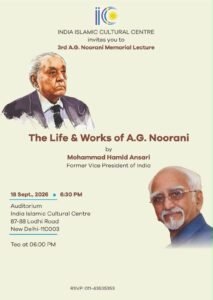
Indeed, Hamid Ansari’s 2026 memorial lecture, published by The Wire, reproduces Noorani’s own argument that Muslim empowerment would not be achieved through communal mobilisation, but through active participation in national political life and by presenting Muslim grievances as part of wider injustices in Indian society.
That observation is crucial.
Because if Noorani himself warned against political mobilisation of Muslims as a separate electoral bloc, then his legacy should not be appropriated by any political camp for vote-bank purposes.
THE WIRE AND NOORANI
In September 2024, a memorial meeting for Noorani was held at the India International Centre.
The meeting was moderated by journalist Qurban Ali.
Among those speaking was Siddharth Varadarajan, founding editor of The Wire.
Former Vice-President Hamid Ansari chaired the meeting; Mani Shankar Aiyar, Salman Khurshid, Harish Khare and N. Ram were also on the panel.
Varadarajan praised Noorani as a meticulous chronicler who documented arguments that repeatedly troubled governments.
That tribute is on record.
So is Varadarajan’s continuing connection with Noorani’s legacy: The Wire published a September 2024 piece titled “Remembering A.G. Noorani: Scholar, Jurist and Conscience Keeper of the Nation”, and also published a Varadarajan video discussing Noorani’s views on what Modi could learn from Israel.
In September 2026, The Wire published Hamid Ansari’s A.G. Noorani Memorial Lecture under the headline:
“A One-man Institution, a Polymath, a Lover of Mughlai Food: A.G. Noorani Was All That and So Much More.”
The article does discuss Noorani’s Babri Masjid scholarship and his writings on the RSS.
Therefore, it would be inaccurate to claim that The Wire simply erased Noorani’s work on Babri Masjid.
But that does not end the investigation.
It begins it .
THE QUESTION OF SELECTIVE REMEMBRANCE
My question is not:
Why did The Wire remember Noorani?
Noorani deserves to be remembered.
My question is:
What version of Noorani is being remembered—and what political meaning is attached to that remembrance ?
Noorani spent decades documenting the history of the Babri Masjid dispute.
He wrote about the events beginning in 1948–49.
He examined the political developments leading to the opening of the locks.
He documented the Ram Janmabhoomi movement.
He examined the demolition of December 6, 1992.
He wrote extensively about the RSS.
And he subjected political claims to documentary scrutiny.
This was Noorani’s journalism.
The challenge for contemporary journalists is therefore straightforward:
Read Noorani’s original documents and compare them with the way his legacy is being politically presented today.
That is the real test.
—
THE 2016 MODI MEETING
There is another piece of the puzzle that deserves examination.
On April 13, 2016, a delegation described by the Prime Minister’s Office as a delegation of “eminent Muslim citizens” met Narendra Modi.
The government’s official press release named, among others, Maulana Kalbe Jawwad, Kamar Agha and former MP Shahid Siddiqui. It said the delegation praised Modi’s development agenda and congratulated him on his Saudi Arabia visit.
But one of the participants, journalist Qurban Ali, publicly disputed that presentation.
According to a contemporary account reproducing The Hindu’s report, Ali said:
“We were invited to discuss the trust deficit between the Muslim community and the government, and what could be done to end this.”
Shahid Siddiqui similarly said that he understood the meeting to concern the economic and educational backwardness of Muslims.
That discrepancy is significant.
The government’s description and the participants’ description were not identical.
A serious investigation should therefore ask:
Who organised the delegation?
Who selected the participants?
What was discussed before they entered the Prime Minister’s Office?
What proposals were actually placed before Modi?
What happened after the meeting?
And:
What political strategy, if any, lay behind bringing these particular Muslim personalities together?
These questions should be answered through contemporary documents and participants’ testimony—not speculation.
QURBAN ALI AND THE SOCIALIST NETWORK
Qurban Ali’s political-media associations also deserve examination.
A 2017 issue of Janata carried an announcement for a Madhu Limaye centenary programme. Its organising committee included Santosh Bhartiya and Qurban Ali, alongside a broad range of socialist and political figures.
This establishes a documented public association.
It does not, by itself, prove that Santosh Bhartiya arranged the 2016 Modi meeting.
Nor does it establish the allegation that Bhartiya operated under RSS patronage.
Those are stronger claims and require the underlying evidence.
But the network is sufficiently documented to justify further investigation.
And the question becomes particularly relevant because the same Qurban Ali later appeared as moderator of the 2024 A.G. Noorani memorial meeting at which Siddharth Varadarajan spoke.
A journalist should therefore map the network rather than make assumptions about it.
MY TWO MEETINGS WITH SIDDHARTH
There is another part of this story that comes from my own experience.
I met Siddharth twice in his Times of India office.
I raised with him my objections to his writings and public positions concerning Muslim leaders and organisations which, in my assessment, were functioning politically in ways that ultimately benefited forces promoting Hindutva.
I did not approach him merely with slogans.
I presented what I regarded as concrete evidence concerning the political relationships and activities of the Muslim leaders and organisations I was questioning.
My argument to him was simple:
If a journalist investigates Hindutva organisations, why should Muslim organisations claiming to represent Muslims receive a lower level of scrutiny?
I asked why political intermediaries who, in my assessment, had compromised Muslim interests should continue receiving legitimacy and public visibility.
I explained why I believed their activities needed to be examined against their political relationships—not merely against their public declarations.
Siddharth heard my arguments.
According to my recollection, however, he did not change his position.
This is my personal testimony.
It does not independently prove that Siddharth or The Wire intended to assist Hindutva.
But it establishes something important from my own journalistic record:
I personally raised this question with him twice, presented what I considered documentary evidence, and challenged him to examine the political record of Muslim intermediaries whom I believed were helping produce the very political consequences he claimed to oppose.
The disagreement remained.
THE QUESTION OF THE “MUSLIM REPRESENTATIVE”
This is where India’s political system deserves deeper scrutiny.
Who gets to represent Indian Muslims?
A political party?
A religious organisation?
A journalist?
A cleric?
A former MP?
A civil-society activist?
A liberal intellectual?
A socialist intermediary?
Or the millions of ordinary Muslim citizens themselves?
The history of independent India shows repeated attempts by political parties to identify selected Muslim leaders as “representatives” of the community.
Congress did it.
Socialist parties did it.
Regional parties did it.
Communist parties did it.
BJP-led politics has also engaged selected Muslim interlocutors.
And Muslim organisations themselves have participated in these relationships.
The result can be a peculiar political economy:
Muslims are repeatedly discussed—but not necessarily allowed to speak independently.
That is the issue that deserves investigation.
HINDUTVA DOES NOT EXIST IN A POLITICAL VACUUM
Hindutva politics must be examined on its own documented record.
But Hindutva’s political success cannot be understood solely by studying Hindutva organisations.
One must also examine the political ecosystem surrounding them.
Electoral polarisation.
Communal mobilisation.
Counter-mobilisation.
Selective representation.
Media amplification.
Muslim vote-bank strategies.
Political intermediaries.
And the repeated presentation of Muslims as a consolidated electoral bloc.
If one side says:
“Muslims are a vote bank.”
and the other side says:
“We alone protect Muslims.”
the public should ask:
Who benefits from keeping Muslims politically defined in precisely those terms?
That is the heart of the “Fixed Fight” investigation.
THE WIRE IS NOT THE RSS
There is an important distinction that must be maintained.
The Wire is not the RSS.
Its journalism has frequently criticised the BJP government and Hindutva organisations. Its own leadership describes the publication as an independent digital news platform, and its record contains extensive reporting critical of the government.
Therefore, saying that The Wire and Hindutva are simply the same political organisation would be factually unsustainable.
The more serious question is different:
Can two political opponents nevertheless become mutually useful within a polarised political ecosystem?
That can happen without secret coordination.
A political movement may benefit from having a clearly identifiable opponent.
An opposing media ecosystem may benefit from having a powerful adversary to investigate and criticise.
Both sides may attract audiences through permanent conflict.
Meanwhile, ordinary citizens can become the raw material of the political contest.
That is why the “Fixed Fight” theory must be tested through evidence rather than slogans.
NOORANI’S WARNING IS MORE IMPORTANT THAN THE MEMORIAL
Perhaps the most revealing element of the 2026 Wire publication is not what Hamid Ansari says about Noorani.
It is what he quotes Noorani saying about Muslim political mobilisation.
Noorani argued that Muslim empowerment would not come through communal mobilisation.
He advocated active participation in national life and presenting Muslim grievances as part of wider injustices in Indian society.
That is a powerful warning to every political camp.
It warns Hindutva politicians against treating Muslims as a permanent communal category.
But it also warns those claiming to represent Muslims against reducing Muslim citizens to a permanent vote bank.
Noorani’s political legacy therefore cannot honestly belong to one side.
BABRI MASJID: THE TEST NOORANI LEFT BEHIND
If today’s journalists really want to honour Noorani, there is an obvious place to begin.
Go back to the documents.
Read his work on the Babri Masjid dispute.
Read the historical record beginning in 1948–49.
Read the legal and political documentation.
Read his account of the demolition.
Read his examination of the RSS.
Then compare the documentary record with the narratives subsequently produced by:
Congress.
BJP.
RSS.
Socialists.
Left organisations.
Muslim organisations.
Liberal media.
The courts.
And finally:
The Wire.
That would be a genuine Noorani project.
Not another memorial.
Not another political speech.
Not another selective quotation.
Documents.
THE REAL INVESTIGATION: FOLLOW THE NETWORK
The investigation I am proposing is therefore not simply:
Hindutva versus The Wire.
It is much bigger.
Follow the people.
Follow the meetings.
Follow the organisations.
Follow the money.
Follow the invitations.
Follow the political statements.
Follow the media coverage.
Follow who gets platformed.
Follow who gets ignored.
Follow who meets whom.
Follow what happens before and after those meetings.
And follow the electoral consequences.
The 2016 Modi meeting provides one documented starting point.
The Qurban Ali–socialist network provides another.
The 2024 Noorani memorial provides another.
The 2026 Noorani lecture provides another.
My two meetings with Siddharth provide a first-person journalistic testimony that I believe deserves to be placed on the record.
None of these individual facts, by themselves, proves a conspiracy.
But together they provide a research trail.
THE QUESTION I PUT ON RECORD
I have spent decades watching Indian political parties claim to represent Muslims while repeatedly negotiating with political establishments on behalf of Muslims.
I have also watched sections of the liberal and left media challenge Hindutva while sometimes giving considerable public legitimacy to Muslim political intermediaries whom I believe deserve much greater scrutiny.
My question is therefore directed at everyone:
Who really benefits when Muslims remain permanently represented by intermediaries ?
Who benefits when Muslim political leadership becomes dependent upon political parties?
Who benefits when Hindutva and “secular” politics define each other?
Who benefits when Muslim citizens are treated primarily as an electoral bloc?
Who benefits when the historical record is replaced by selective political remembrance?
And who benefits when the dead—including a fearless scholar like A.G. Noorani—become symbols in today’s political battles rather than authors whose original documents are actually read?
NOORANI DESERVED BETTER
A.G. Noorani spent his life doing something increasingly rare:
He followed documents.
He built timelines.
He read court records.
He challenged official narratives.
He criticised governments.
He criticised political movements.
And he wrote uncomfortable truths.
The best tribute to Noorani is therefore not to turn him into a convenient icon for the Left, Congress, Hindutva, Muslim organisations or liberal media.
The best tribute is to do what he did:
Go back to the record.
If the record disproves my allegations, publish it.
If the record confirms them, publish that too.
If the evidence exposes Hindutva, expose Hindutva.
If it exposes Congress, expose Congress.
If it exposes socialist intermediaries, expose them.
If it exposes Muslim leadership, expose it.
And if it exposes weaknesses in the liberal-left media itself, do not protect the media merely because it calls itself secular.
That is the standard journalism owes the public.
That is the standard A.G. Noorani’s work demands.
And that is why the real investigation has only begun.
THE FIXED FIGHT MUST BE TESTED—NOT BELIEVED.
THE SOCIALIST–RSS QUESTION: QURBAN ALI’S OWN RECORD
Journalist Qurban Ali has written about how socialist politics helped create political space for Hindu nationalism. In his March 2024 Caravan essay, “Left Behind: How the socialists enabled the Hindu Rashtra,” he traced the shift from Jayaprakash Narayan’s post-1948 condemnation of the RSS and Hindu Mahasabha to his later cooperation with the Jana Sangh during the anti-Indira Gandhi movement.
The essay is a documented source for Ali’s interpretation of this political shift. To verify the underlying history, researchers would need the relevant speeches, correspondence, organisational records, contemporary news reports and other primary sources concerning Narayan, the RSS, the Hindu Mahasabha and the Jana Sangh.
Ali’s argument is that this process helped remove the political taboo surrounding the Sangh and bring Hindu nationalism into the mainstream. This is an interpretation rather than an independently established fact. It could be assessed by examining electoral data, party alliances, public statements, organisational records, media coverage and evidence of changes in public and elite attitudes before and after the relevant collaborations.
In another article, Ali argued that some socialists’ anti-Congress strategy became an end in itself, producing consequences that undermined their stated ideological goals. This is Ali’s published interpretation. Establishing or challenging it would require identifying the actors and decisions he discusses, comparing their stated objectives with their conduct and examining the political consequences through contemporary records.
The historical question is therefore:
DID THE ANTI-CONGRESS STRATEGY OF THE SOCIALISTS HELP CREATE THE POLITICAL SPACE IN WHICH THE RSS/BJP EVENTUALLY ROSE TO POWER ?
Ali’s own writing establishes that he makes this argument. It does not, by itself, establish that anti-Congress politics caused or substantially enabled the BJP’s rise. That broader claim remains a historical hypothesis requiring a documented chronology, evidence of causal links, comparison with alternative explanations and analysis of the roles of socialist parties, the Jana Sangh, the RSS, regional parties, the Congress and other actors.
The question then turns to the individuals who participated in that political tradition. Any claim about an individual’s role should be based on identifiable actions, records or testimony rather than association alone.
MY PERSONAL KNOWLEDGE OF QURBAN ALI AND SANTOSH BHARTIYA
I personally knew Qurban Ali and Santosh Bhartiya. After my car accident in Delhi, both visited my house, giving me direct interactions with them beyond their public writings.
This is a personal recollection. Its accuracy could be supported by contemporaneous correspondence, medical or visitor records, photographs, witnesses or other independent evidence, although the absence of such evidence would not by itself disprove the recollection.
I state the following as personal testimony and political assessment, not as a court-established fact:
I BELIEVE SANTOSH BHARTIYA WORKED POLITICALLY IN WAYS THAT SERVED THE INTERESTS OF THE RSS/BJP IN WEAKENING THE CONGRESS, PARTICULARLY THROUGH THE BOFORS CONTROVERSY AND THE MOBILISATION AROUND V.P. SINGH.
What is established here is only that I hold this belief. The claim that Bhartiya acted in the interests of, or in coordination with, the RSS/BJP remains an allegation and interpretation, not a documented finding. It should not be presented as proof of covert coordination without evidence. Relevant evidence would include Bhartiya’s contemporaneous articles, communications, organisational affiliations, meetings, financial or logistical links, statements by participants and records showing whether his actions were coordinated with, knowingly benefited or were directed by the RSS or BJP.
The Bofors controversy damaged the Rajiv Gandhi government and helped bring V.P. Singh to the centre of national politics. These developments are historical claims that can be examined through parliamentary records, investigative reports, court documents, contemporary journalism, party records, polling data and other contemporaneous sources.
But while Bofors’s political impact is historically documented, the claim that a particular journalist acted on behalf of the RSS/BJP requires separate evidence. Evidence of political effect is not, by itself, evidence of intention, coordination or agency.
My evidence begins with personal knowledge; the allegation should be tested against contemporary records. My personal knowledge may establish what I directly observed or was told, but it cannot by itself establish another person’s motives or organisational instructions.
V.P. SINGH: THE MAN I KNEW
I knew V.P. Singh personally. From my interactions with him, I did not see him as someone willing to accept every strategy used by those around him. This is a personal recollection and impression, not a complete account of Singh’s political conduct. It could be assessed through contemporaneous correspondence, speeches, interviews, decisions, accounts by other participants and records of the relevant political negotiations.
In particular, I observed a difference between his approach and what I regarded as the “use and throw” treatment of Muslims by some operators in the wider anti-Congress movement. The observation is based on my experience; the characterisation of other operators is an interpretation and potentially an allegation. To substantiate it, one would need to identify the operators, specify the conduct alleged and examine their statements, decisions, communications and treatment of Muslim political actors over time.
It would therefore be simplistic to portray Singh as merely an instrument of the RSS or BJP. This is an analytical judgment. It should be tested against Singh’s own statements and actions, the terms of political agreements, the conduct of the BJP and RSS, and evidence of conflict or cooperation among the coalition’s participants.
The coalition included socialists, regional parties, the BJP/Jana Sangh tradition and other forces with divergent aims. The existence of these participants and their divergent ideological positions is a historical claim requiring party documents, public statements, electoral records and contemporary reporting. The extent to which their aims diverged in particular decisions requires a more specific examination of those decisions.
The relevant question is not:
“Was V.P. Singh an RSS man ?”
That question should be answered only through evidence concerning Singh’s affiliations, statements, decisions and relationships, and should not be inferred from coalition membership alone.
It is:
HOW DID DIFFERENT POLITICAL FORCES USE THE SAME ANTI-CONGRESS MOVEMENT FOR DIFFERENT OBJECTIVES?
The article establishes that these forces operated within a common anti-Congress political space and that their objectives cannot be inferred from alliance membership alone. It does not establish what each actor intended in every decision. Answering that question requires a documented chronology of the movement, identification of each actor’s stated objectives, evidence of their actions and analysis of the consequences for each participant.
FROM BOFORS TO THE RISE OF HINDUTVA
The anti-Congress coalition helped make the BJP and its ideological predecessors increasingly important national players. This is a historical interpretation that requires evidence from election results, parliamentary representation, coalition agreements, party records, organisational growth, public opinion and contemporary reporting.
Ali’s historical analysis provides a framework for examining how socialist engagement with the Sangh helped normalise Hindu nationalist politics. That is Ali’s interpretation and a useful research hypothesis, not conclusive proof. It should be tested against evidence of public rhetoric, institutional access, electoral change, media treatment and the conduct of socialist and Sangh organisations before, during and after their cooperation.
The investigation should distinguish among several questions:
– Did anti-Congress politics unintentionally strengthen the RSS/BJP ?
This remains a causal historical question, not an established conclusion. It requires evidence of political changes attributable to the strategy, while accounting for other factors such as Congress policy, social movements, economic conditions, communal mobilisation and organisational expansion.
– Did particular intermediaries consciously facilitate that process? This remains a claim about individual intention and conduct. It requires contemporaneous communications, meetings, instructions, financial or organisational links, testimony and evidence that the intermediaries understood and pursued the alleged objective.
Were Muslim political leaders used as instruments in the contest ?
This remains an allegation about political relationships and agency. It requires identifying the leaders and alleged users, documenting the relevant arrangements or conduct and examining whether the leaders acted independently, under pressure or in coordination with others.
– Did sections of the liberal-left media reproduce similar intermediary politics under the language of secularism? This remains a broad institutional interpretation. It requires defining the media actors and organisations, analysing their coverage and affiliations and comparing their stated principles with their selection of sources, subjects and political interventions.
The first question concerns political history; the others require evidence about individuals and institutions. None should be resolved solely through association, ideological labels or retrospective inference.
THE PARADOX OF QURBAN ALI
Ali’s writing documents how socialist politics helped enable Hindu nationalism, yet he has also participated in contemporary networks involving socialist figures. The first proposition refers to Ali’s published argument; the second is a claim about his public associations and should be verified through event programmes, organisational records, publications and other reliable sources.
A 2017 Janata publication lists Qurban Ali and Santosh Bhartiya together on the organising committee of a socialist programme. This is a specific documentary claim that can be checked against the original publication, the organisation’s records and independent contemporary reporting.
This does not prove that either man secretly worked for the RSS. That conclusion would require direct or circumstantial evidence of secret coordination, instructions, funding, communications or conduct that cannot reasonably be explained by ordinary political association.
It does, however, document an intersection of their public political networks and provide a trail for investigation. The significance of that intersection remains an interpretation. It would require examining the programme’s purpose, the participants’ roles, their subsequent conduct and any evidence of coordination with the RSS or BJP.
THE QUESTION OF THE MUSLIM “INTERMEDIARY”
Qurban Ali was among the prominent Muslims who met Narendra Modi in 2016. The meeting is documented, subject to verification through official records, participant accounts, photographs, contemporaneous reporting and other primary sources.
Ali later described its purpose differently from the government’s public account, saying the delegation had been invited to discuss the “trust deficit” between Muslims and the government. The difference between the accounts should be established by comparing the government’s statement, Ali’s statement, other participants’ accounts, invitations, agendas, correspondence and any available recordings or minutes.
The meeting does not itself prove wrongdoing. Nor does participation establish that Ali acted as an intermediary for the government, the BJP or the RSS. Such a claim would require evidence of selection, instructions, coordination, benefits, promises or subsequent political conduct demonstrating that role.
But political access is a legitimate subject of journalism:
Who arranged the meeting? Who selected the delegates? What were they briefed to ask? What did Modi promise or reject? What followed? Why were those participants chosen to represent Muslims?
These questions require documents and testimony, including invitations, correspondence, briefing notes, participant accounts, official records, follow-up communications and evidence of subsequent actions. The answers should distinguish what is documented from what is inferred.
MY QUESTION TO THE WIRE
I raised related concerns with Siddharth during two meetings at his Times of India office. I questioned his writings and support for Muslim political personalities and organisations whom I believed had become intermediaries for political establishments.
The meetings and their content are my personal recollection. They could be corroborated by diaries, correspondence, office records, witnesses or contemporaneous notes. My belief that particular personalities or organisations had become intermediaries is an interpretation and allegation requiring evidence of their relationships, instructions, benefits, conduct and political effects.
My position was that Muslim political leadership should not be exempt from scrutiny merely because it presents itself as secular or representative. This is a normative argument. It does not establish that any particular leader or organisation acted improperly.
If journalists investigate the RSS, BJP and Hindutva, they should also investigate those claiming to represent Muslims. Otherwise, journalism may reproduce the vote-bank politics it seeks to oppose. This is an argument about journalistic standards and a possible institutional effect. Testing it would require a comparative review of coverage, source selection, investigative practices and treatment of political actors across communities.
According to my recollection, Siddharth heard my arguments but maintained his position. This is my first-person account, not independent proof of his motives. Establishing what he believed or why he maintained his position would require his own contemporaneous statements, correspondence, published explanations or testimony. His disagreement alone would not prove political coordination or improper motive.
NOORANI’S LEGACY MAKES THIS QUESTION EVEN MORE IMPORTANT
A.G. Noorani’s method was to distrust political labels and examine documents. This is a characterisation of his method and should be assessed through his published work, sources, citations and stated research practices.
He investigated the RSS, the State, Muslim politics, Congress, the judiciary and the historical record. These are documented subjects of his writing, although the quality and conclusions of each investigation remain open to evaluation through his sources and the underlying evidence.
That method should be applied to the alleged “Fixed Fight.” The phrase “Fixed Fight” is an allegation or interpretive framework, not an established fact. To investigate it, one would need to define the alleged arrangement, identify the participants, specify the conduct said to constitute coordination and examine documents, communications, financial records, testimony and outcomes.
The article establishes a set of documented claims: Ali has published a particular interpretation of socialist engagement with Hindu nationalism; certain political meetings, publications and associations can be checked against primary records; and my own accounts are personal recollections and assessments. It does not establish covert coordination, individual agency on behalf of the RSS/BJP, improper representation of Muslims or a deliberately “fixed” political contest.
Not:
Hindutva versus secularism.
Not:
BJP versus Congress.
Not:
Left versus Right.
But:
WHO DID WHAT, WITH WHOM, WHEN, AND FOR WHAT POLITICAL CONSEQUENCE ?
A rigorous investigation should seek contemporaneous correspondence, meeting records, invitations, agendas, party and organisational files, financial and logistical records, published statements, parliamentary material, electoral data, media archives, participant testimony and evidence of subsequent actions. It should test competing explanations, distinguish intention from effect and identify what evidence would confirm or disprove each allegation.
The conclusions should therefore be stated in separate categories: what the documents directly show; what participants personally recall; what follows as a reasonable historical interpretation; and what remains unproven. Association may justify further inquiry, but it cannot substitute for evidence of coordination, motive or agency.
That is the Noorani method—and the investigation Indian journalism still owes the public.
— Ahmed Sohail Siddiqui
Chief Editor, Journalist, Activist & Author.