
 When an Electoral Dispute Becomes an International Anti-Muslim Modi Narrative
How an unresolved voter-roll controversy is being presented to the world as “Modi striking millions of Muslims”
An investigation into the Telegraph’s framing, the politics of manufactured insecurity, and the danger of turning India’s Muslims into a permanent political constituency of fear
By Ahmad Sohail Siddiqui
Senior Journalist, Editor & Author
There is a new and disturbing dimension to India’s Special Intensive Revision (SIR) controversy.
It is no longer confined to the Election Commission, opposition parties, courts and Indian voters.
It has now become an international media narrative about Narendra Modi, the BJP and Indian Muslims.
And the latest example deserves particularly close examination.
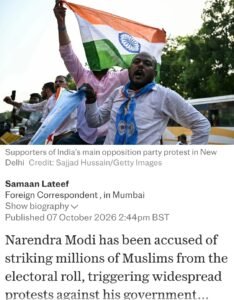
On October 7, 2026, The Telegraph published a report under the headline:
“Modi accused of striking millions of Muslims from electoral roll.”
The report describes the removal of more than 130 million names during the electoral-roll revision and presents opposition allegations that the exercise disproportionately affects India’s Muslims and benefits the BJP.
But the headline itself raises an important journalistic question:
Has an allegation about the political and demographic consequences of an electoral-roll revision been transformed into an internationally understood fact about Muslims being removed by Narendra Modi?
That distinction is not semantic.
It is the difference between reporting a controversy and constructing a narrative.
First, let us be absolutely clear: there is a real SIR controversy
There is no justification for pretending that nothing is happening.
The Election Commission’s Special Intensive Revision has generated serious political, legal and administrative controversy.
Opposition parties have accused the Election Commission and Chief Election Commissioner Gyanesh Kumar of disenfranchising legitimate voters.
There have been protests.
There have been individual complaints from voters whose names were removed or placed under adjudication.
There have been questions regarding the functioning of the Election Commission.
The Supreme Court has issued notices to the Election Commission and the Centre over a petition challenging the manner in which decisions were taken under the leadership of Gyanesh Kumar. The Court specifically stated that if any Election Commission decision is found contrary to law, it can annul that decision. It also clarified that the Supreme Court had not approved the modified Form 6 used in the controversy.
Those are serious developments.
They deserve serious journalism.
But serious journalism requires another equally important distinction:
A disputed electoral process is not automatically proof of a communal conspiracy.
The Telegraph headline deserves scrutiny
The Telegraph report does not merely say:
«Opposition parties accuse the government of disenfranchising Muslims.»
It says:
“Modi accused of striking millions of Muslims from electoral roll.”
That construction places Narendra Modi and “millions of Muslims” together in the reader’s mind before the reader encounters the qualifications and competing explanations later in the article.
The report does attribute the allegation to critics.
It also reports that the Election Commission and BJP deny the charge.
But the psychological impact of a headline often precedes the qualifications contained inside the story.
A reader in London, New York or Washington who knows little about India’s electoral machinery can easily come away with a very different impression:
Modi is removing Muslims from India’s electoral rolls.
That is a much more definitive proposition than:
Opposition parties allege that the SIR process disproportionately affects Muslims.
These are not the same statement.
The “Modi appointed Election Commission” formulation also needs examination
The report describes the Election Commission as an electoral body “appointed by Mr Modi.”
That formulation requires greater constitutional context.
The appointment mechanism for the Election Commission is governed by India’s constitutional and statutory framework; it is not accurately understood simply as Narendra Modi personally appointing the Chief Election Commissioner.
More importantly, even where political executives participate in an appointment process, the institutional actions of a constitutional authority cannot automatically be described as personal actions of the Prime Minister.
If Gyanesh Kumar has committed an unlawful act, the evidence should establish:
what he did, when he did it, under which authority, and how it was connected to the Prime Minister or government.
Institutional accountability cannot be replaced by political shorthand.
The crucial distinction the international reader may miss
There is another issue which is particularly important.
Removal from an electoral roll is not itself cancellation of citizenship.
An electoral roll determines who is registered to vote.
Citizenship is a separate legal status.
The Election Commission has said the purpose of SIR is to clean electoral rolls by identifying categories including people who are dead, have shifted residence, appear more than once or are otherwise ineligible.
Chief Election Commissioner Gyanesh Kumar has publicly stated that complaints concerning excluded names can be taken through the prescribed appeal mechanisms.
That process can—and should—be criticised where it fails citizens.
But a voter being removed from a roll does not automatically mean that the Indian state has declared that person a non-citizen.
This distinction becomes particularly important when political communication begins telling Muslims that their citizenship itself is being taken away.
This is where yesterday’s story becomes relevant
In my previous article, “The Muslim Vote Is Not Your Political Property: A Protest Against the New Politics of Manufactured Insecurity,” I raised precisely this danger.
The Muslim citizen must not become a permanent political captive through fear.
For decades, sections of India’s political class have repeatedly told Muslims that an existential catastrophe awaits them unless they vote for particular parties or political formations.
The language changes.
Sometimes it is:
“Your mosque is in danger.”
Sometimes:
“Your personal law is in danger.”
Sometimes:
“Your citizenship is in danger.”
And now:
“Your name is being removed from the voter list.”
Every generation receives a new version of the same political fear.
The result is predictable:
Fear produces political mobilisation.
Political mobilisation produces protests.
Protests generate international headlines.
International headlines intensify fear among the very people who were already frightened.
And the cycle continues.
Who benefits from the cycle?
This is the question that has not been sufficiently examined.
Suppose a Muslim voter reads that millions of Muslims are being removed from India’s electoral rolls.
He becomes frightened.
He hears opposition leaders saying that his vote and perhaps his citizenship are under threat.
He comes onto the streets.
International media photographs the protests.
The next day’s international headline says:
“Muslims protest against Modi’s voter purge.”
The headline then reaches millions of Muslims in India through social media.
Their fear increases.
More people protest.
More international reports follow.
The narrative becomes self-reinforcing.
Who benefits from that political psychology?
That question should be asked without assuming the answer.
But there is another side that must not be hidden
An investigation cannot become credible by simply defending the Election Commission.
There are legitimate concerns.
Reports have documented disagreements among Election Commissioners over aspects of the SIR process.
The Supreme Court is examining challenges concerning the functioning of the Commission.
There have been individual cases of people alleging wrongful deletion.
There have also been allegations in Karnataka and elsewhere concerning attempts to submit voter-deletion forms against Muslim voters.
One such Karnataka case resulted in a police complaint alleging that individuals sought to target Muslim voters specifically.
These allegations deserve investigation.
If someone deliberately attempts to delete a genuine citizen’s vote because that citizen is Muslim, that is an extremely serious matter.
If a political party or its agents are responsible, they must be exposed.
But an alleged illegal deletion by an individual or group is not automatically proof that Narendra Modi ordered millions of Muslims removed from the national electoral roll.
That connection requires evidence.
The international media must apply the same standard to India that it applies elsewhere
This is where the role of international journalism becomes critical.
International media has enormous influence.
For millions of readers outside India, The Telegraph, The Times, Reuters, BBC, CNN and similar organisations effectively become their primary window into Indian politics.
Therefore, when such organisations use terms such as:
“Muslim purge,”
“striking millions of Muslims,”
“disenfranchising minorities,”
or portray the entire electoral exercise as a Modi-directed attack on Muslims,
they carry a responsibility greater than that of a partisan political organisation.
The question is not whether such allegations may be reported.
Of course they should be.
The question is:
What evidence accompanies the allegation?
Show us the numbers
If millions of Muslims have been specifically removed, then journalism should establish the numbers.
How many names were deleted?
How many belonged to Muslims?
How was the religion of deleted voters established?
How many were dead?
How many had shifted?
How many were duplicate entries?
How many were restored?
How many appeals were successful?
How many remained pending?
How many deletions occurred in Muslim-majority constituencies compared with Hindu-majority constituencies?
How many deletion applications were submitted by political agents?
Were those applications verified independently?
And most importantly:
Where is the documentary evidence connecting the alleged Muslim-specific deletions to Narendra Modi personally?
These are not unreasonable questions.
They are the minimum requirements of an investigative story.
The word “Muslim” itself is becoming a political instrument
There is another problem.
When a newspaper repeatedly frames every electoral dispute through the Muslim question, it risks unintentionally converting Indian Muslims from citizens into a permanent political category.
The Muslim becomes:
a vote bank,
a threatened minority,
a protester,
a victim,
or a political weapon.
But the Muslim citizen is much more than any of these labels.
He or she is an Indian citizen with constitutional rights.
The Muslim community has the right to criticise Modi.
It has the right to support Modi.
It has the right to oppose the BJP.
It has the right to vote Congress.
It has the right to vote for regional parties.
It has the right to vote for independent candidates.
And it has the right to reject every political party claiming to speak on its behalf.
That is democracy.
Do not confuse Muslim insecurity with Muslim empowerment
This is perhaps the central argument of this investigation.
A political system that continually tells Muslims:
“You are unsafe without us”
does not necessarily empower Muslims.
It can make them permanently dependent upon political intermediaries.
The same people who claim to be protecting Muslims can then demand Muslim votes as compensation for that protection.
This is the politics of manufactured insecurity.
And it is not confined to India.
It is a familiar political technique across the world:
Create fear → identify yourself as the protector → demand political loyalty.
The Congress-Gandhi question
The role of the Congress opposition deserves independent scrutiny as well.
Congress leaders have made some of the strongest allegations against Gyanesh Kumar and the Election Commission.
Those allegations must be investigated.
But Congress also has a long political history of presenting itself as a principal political representative of Indian Muslims.
That creates a legitimate journalistic question:
Is the present mobilisation exclusively about electoral integrity, or is Muslim anxiety also being converted into political mobilisation against the Modi government?
That question does not accuse Congress of fabricating every allegation.
It asks journalists to examine the political incentives of every actor involved.
The BJP should face scrutiny.
The Election Commission should face scrutiny.
Congress should face scrutiny.
Regional opposition parties should face scrutiny.
And international media should face scrutiny.
No one should receive a permanent exemption.
The Supreme Court makes the story more complicated—not simpler
The international narrative often becomes cleaner when complicated facts are removed.
But the Supreme Court proceedings demonstrate that the situation is more complicated.
The Court has not simply declared:
“Modi is deleting Muslims.”
Nor has it simply declared:
“The Election Commission has done nothing wrong.”
Instead, it has demanded answers and examined questions concerning the Commission’s decision-making and electoral procedures.
That is precisely how constitutional democracy is supposed to work.
Evidence is produced.
Arguments are heard.
Institutions are questioned.
And courts decide.
There may be genuine victims—but they must not become political statistics
Every citizen whose legitimate vote has been wrongly deleted deserves justice.
Whether that citizen is Muslim, Hindu, Christian, Sikh, Buddhist or belongs to any other community is irrelevant.
The right to vote cannot depend upon political loyalty.
If an Indian citizen has been wrongly removed, restore the name.
If an officer acted improperly, investigate.
If a political party submitted fraudulent deletion applications, prosecute.
If a constitutional authority violated the law, hold it accountable.
But if the evidence does not establish a nationwide Muslim-targeting conspiracy, journalism should not manufacture one through headlines.
The real investigation has yet to begin
Instead of asking only:
“Is Modi anti-Muslim?”
journalists should ask:
How many genuine voters were wrongly removed?
How many were Muslim?
Why were they removed?
Who initiated each disputed deletion?
How many were restored?
How effective were the appeals?
Were political agents involved?
Were government officials involved?
Was there discriminatory implementation?
And is there evidence connecting the Prime Minister personally to any unlawful deletion?
These questions can produce facts.
Labels cannot.
The international media should investigate India—not prosecute it through headlines
India’s democracy should neither be protected from criticism nor condemned without evidence.
If Modi’s government has unlawfully disenfranchised citizens, expose it.
If the Election Commission has failed, expose it.
If Muslims have been disproportionately and deliberately targeted, document it.
But if political allegations are being amplified beyond the evidence, expose that too.
That is not pro-Modi journalism.
It is journalism.
And if international media organisations want to retain credibility among India’s 1.4 billion citizens, they must understand one simple principle:
Indian Muslims are not merely a “minority story.”
They are citizens.
Their fears are real.
Their grievances deserve investigation.
But their fears should never become raw material for political parties—or international media narratives.
The question that India must now ask
Perhaps the most important question is not:
“Is Narendra Modi anti-Muslim?”
Nor:
“Is the opposition lying?”
Those are political conclusions.
The real question is:
Who is manufacturing certainty out of an unresolved controversy—and who benefits when frightened Indian Muslims are persuaded that their citizenship, their vote and their future are simultaneously under existential threat?
That question deserves an answer.
And it deserves an answer based not on slogans, headlines or political speeches—
but on evidence.
( By Ahmad Sohail Siddiqui
Senior Journalist, Editor & Author. The key factual basis for the update is the Telegraph report itself as reproduced/syndicated in search results: it says more than 130 million names were removed, reports the opposition’s allegation that Muslims were disproportionately affected, and also records the denials by the BJP and Election Commission.
The wider context is important too: Reuters independently reports that protesters allege the voter-roll changes benefit the BJP, while the ECI says the exercise is intended to remove duplicate, deceased or otherwise ineligible entries; and the Supreme Court has sought responses concerning the functioning of the Commission.
This makes the revised article stronger because it does not deny the documented SIR controversy; it challenges the journalistic leap from “alleged disproportionate impact on Muslims” to the headline-level impression that Modi is personally “striking millions of Muslims” from India’s electoral rolls. )
********