
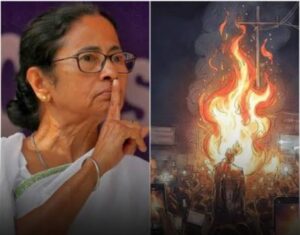
 The Battle for Democracy: Questions, Claims, and the Politics of Trust in India’s Electoral System

By Ahmed Sohail Siddiqui
In the world’s largest democracy, the credibility of elections is not just a procedural necessity—it is the very foundation of legitimacy. Every vote cast is a citizen’s faith placed in the system. And when that faith is questioned, even by perception, the consequences ripple far beyond ballot boxes.
The recent political developments involving the Election Commission of India, the rise of the Bharatiya Janata Party under Narendra Modi, and the resistance led by Mamata Banerjee have once again brought the integrity of India’s electoral process under intense scrutiny.
Among the most controversial voices in this debate is that of Syed Shuja, who in past public appearances—including widely circulated online broadcasts—has claimed that India’s Electronic Voting Machine (EVM) system can be manipulated. His assertions, however, have been repeatedly rejected by Indian authorities, and he has not provided verifiable, legally tested evidence that stands scrutiny in a court of law.
Yet, the persistence of such claims—whether credible or not—points to a deeper issue: a growing trust deficit.
The West Bengal Political Theatre
West Bengal has long been a battleground of ideology, identity, and power. Mamata Banerjee, a leader who rose through grassroots mobilization, has positioned herself as a defender of constitutional values and regional autonomy.
Her repeated electoral successes have cemented her image as a resilient political force. However, every election cycle in the state has also been accompanied by fierce accusations—from all sides—of unfair practices, ranging from voter intimidation to administrative bias.
EVM Debate: Technology vs Trust
India’s EVM system has been defended by the Election Commission of India and backed by multiple technical committees, as well as rulings from the Supreme Court of India, which have upheld its reliability when used with VVPAT (Voter Verified Paper Audit Trail).
However, critics argue that technical assurance alone does not resolve political distrust. In democracies, perception often becomes reality. Even the suspicion of manipulation—if widespread—can erode legitimacy.
The BJP’s Expanding Footprint
The electoral dominance of the Bharatiya Janata Party across multiple states has been attributed by supporters to organizational strength, ideological consolidation, and leadership under Narendra Modi.
Opponents, however, have raised concerns over the role of institutions, media narratives, and campaign financing—arguing that the playing field is not always level.
Democracy’s Toughest Test
At the heart of this debate lies a fundamental question:
Can a democracy survive if a significant portion of its population loses trust in how leaders are elected?
Mamata Banerjee’s political positioning as someone who operates within constitutional limits—despite fierce opposition—has strengthened her image among supporters as a leader unwilling to compromise democratic norms.
At the same time, her critics accuse her government of its own governance failures and political tactics, reminding us that no side in Indian politics is free from scrutiny.
The Road Ahead: Courts, Citizens, and Credibility
India’s democratic resilience has historically depended on its institutions—especially the judiciary. Any credible evidence of electoral malpractice must ultimately be tested in courts, not just debated in political rallies or digital platforms.
Citizens, too, have a role: to demand transparency, question authority, and resist both blind trust and reckless misinformation.
Conclusion: Between Allegation and Evidence
India stands at a crossroads where allegations, perceptions, and political narratives are colliding with institutional assurances.
If there is truth to claims of manipulation, it must be proven through evidence and legal process.
If not, then restoring trust becomes an equally urgent task.
Because in the end, democracy is not just about who wins elections—
it is about whether people believe those victories are real.
—