
 Catching the Israeli Agents by the Collar? Rahul Gandhi’s Allegations, India’s Security Debate, and the Demand for Accountability
An Investigative Analysis
By Ahmed Sohail Siddiqui
Indian politics witnessed another dramatic confrontation when Leader of the Opposition Rahul Gandhi alleged that security forces used pellet guns against protesting students and activists. The allegations have reignited debate over crowd-control methods, India’s defence cooperation with Israel, and the accountability of the Union Government.
Supporters of Rahul Gandhi argue that the incident represents more than excessive use of force. They contend that it reflects a broader security doctrine increasingly influenced by Israeli counter-insurgency practices. Government supporters, however, reject such allegations and maintain that Indian security agencies act independently under Indian law.
These competing narratives raise important questions deserving careful investigation.
Prof.Shamsul Islam Exposing the Pellet Gun Israel India partnership in India.
The Pellet Gun Controversy
Pellet-firing shotguns have long attracted criticism from human-rights organisations because they can cause serious eye injuries and permanent disability. Their use has been particularly controversial in Jammu and Kashmir over the past decade.
Rahul Gandhi’s criticism suggests that similar methods are now allegedly being employed against protesters elsewhere in India. If true, critics argue, this would represent an expansion of highly controversial policing tactics.
Whether pellet guns were actually deployed in the reported incident—and under whose orders—requires independent verification through official records, medical evidence, and judicial scrutiny.
India’s Expanding Defence Relationship with Israel
India today is among Israel’s major defence partners. The relationship includes cooperation in:
- Air-defence systems
- Surveillance technologies
- Drones
- Intelligence sharing
- Border-management equipment
- Cyber-security
These defence ties have expanded under successive governments, including both Congress-led and BJP-led administrations, though they have become more publicly visible during Prime Minister Narendra Modi’s tenure.
However, the existence of defence cooperation does not by itself establish that Israeli officials or agents direct Indian policing operations.
Allegations Regarding Israeli Influence
Some political activists argue that Israeli security doctrines are influencing India’s internal law-enforcement strategies.
Such claims require strong evidence.
At present, no publicly verified evidence demonstrates that Israeli government agents directed the alleged pellet-gun deployment in Delhi or controlled Indian security operations.
Nevertheless, critics are demanding greater transparency regarding:
- procurement of crowd-control equipment,
- training programmes involving foreign partners,
- intelligence cooperation,
- and oversight of imported security technologies.
Rahul Gandhi’s Confrontation
Supporters describe Rahul Gandhi’s actions during the confrontation as an example of political courage, claiming that he remained calm despite physical confrontation while attempting to protect fellow protesters.
Government supporters dispute this characterization and accuse the opposition of politicising security operations.
As with many politically charged incidents, independent documentation remains essential.
Manufacturing Crowd-Control Weapons
The allegations also raise broader policy questions.
If pellet guns or similar crowd-control weapons are being manufactured domestically under technology transfers or licensing arrangements, Parliament may legitimately ask:
1.Who approved such production?
2.Which agencies procure these weapons?
3.Under what legal framework are they authorised?
4.What safeguards exist against misuse?
5.Are they consistent with India’s constitutional protections and international human-rights obligations?
These questions warrant transparent answers irrespective of party politics.
Parliamentary Oversight
The controversy highlights the importance of parliamentary scrutiny.
The Opposition may seek:
- disclosure of procurement contracts,
- details of crowd-control policies,
- judicial inquiries into alleged excessive force,
- and accountability if any violations of law are established.
Such oversight is a normal feature of a constitutional democracy.
The Need for Evidence-Based Accountability
Allegations linking domestic policing directly to foreign governments are serious and should be investigated carefully rather than assumed to be true or dismissed outright.
If evidence establishes misconduct, those responsible should be held accountable under Indian law. Conversely, if allegations are not substantiated, public debate should reflect that outcome as well.
Ultimately, democratic institutions are strengthened by transparent investigations, independent judicial review, parliamentary oversight, and respect for constitutional rights. Any claims of excessive force, unlawful surveillance, or inappropriate foreign influence deserve careful examination based on verifiable evidence rather than speculation alone.
From Pellet Guns to Questions of Foreign Security Influence: Rahul Gandhi Demands Answers from Amit Shah
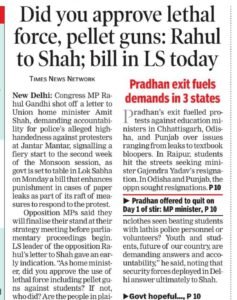
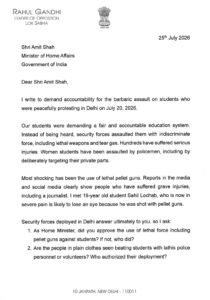
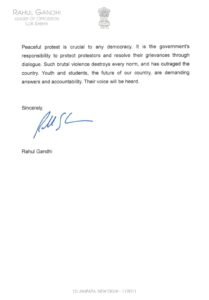
Leader of the Opposition Rahul Gandhi has escalated the controversy over the July 20 student protest crackdown by sending a detailed letter dated 25 July 2026 to Union Home Minister Amit Shah, demanding accountability for what he describes as a “barbaric assault” on peaceful protesters.
The letter raises serious allegations regarding the use of pellet guns, tear gas, and force against students, while also questioning the presence of unidentified plain-clothed individuals allegedly participating in the assault.
A Letter That Raises Serious Questions
In his letter, Rahul Gandhi alleges that:
Security forces used pellet guns against students.
Hundreds of protesters sustained serious injuries.
Women students were allegedly assaulted, including by targeting private parts.
A 19-year-old student, Sahil Lochab, may lose an eye after allegedly being struck by pellets.
Individuals in plain clothes were seen beating students with lathis.
Rahul Gandhi asks Home Minister Amit Shah two direct questions:
1. Did the Home Minister approve the use of pellet guns and lethal force against students? If not, who authorised it?
2. Were the plain-clothed individuals police personnel or volunteers, and who authorised their deployment?
These questions have entered the public domain through his signed letter and subsequent media reports.
The Pellet Gun Debate
Pellet guns have remained controversial because of their potential to cause permanent injuries, particularly blindness. Their reported use in Delhi, if confirmed through official investigation, would represent a significant development in India’s crowd-control practices.
The government has not publicly accepted the allegations contained in Rahul Gandhi’s letter, and the circumstances surrounding the reported use of pellet guns remain a matter of dispute.
Allegations of Foreign Security Influence
Some political commentators and activists have argued that India’s growing security cooperation with Israel warrants greater transparency regarding training, procurement, and crowd-control methods.
However, the documents provided do not establish that Israeli agents were present in Delhi or that Israel directed the police response. Those claims remain allegations and would require independent evidence before they could be presented as fact.
Call for an Independent Inquiry
Given the gravity of the allegations—including the reported use of pellet guns, serious injuries, and the involvement of unidentified individuals—there is a strong public interest in an independent investigation to establish:
Whether pellet guns were used;
Who authorised their deployment, if they were;
The identity and authority of any plain-clothed personnel involved;
Whether existing laws and police procedures were followed.
Only a transparent judicial or independent inquiry can determine the facts and assign responsibility where appropriate.
—
The attached letter and newspaper clipping strengthen the article by documenting Rahul Gandhi’s allegations and demands for accountability, but they should not be used to present unverified claims—such as the involvement of Israeli agents or a foreign-directed operation—as established facts without supporting evidence.
********