
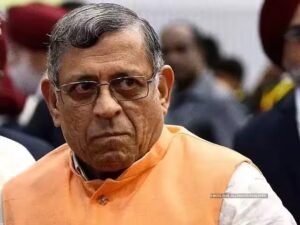
 The Debate Over Dissent: S. Gurumurthy’s ‘Iron Hand’ Remark and the Boundaries of Democratic Discourse
An Investigative Analysis

By Ahmed Sohail Siddiqui
As protests by students over examination-related issues intensified in New Delhi, one social media post from commentator and RSS ideologue S. Gurumurthy became the centre of a wider debate on free speech, state power and democratic accountability.
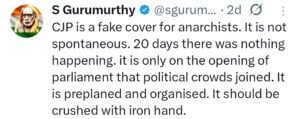
Gurumurthy wrote on X that the protests were “preplanned and organised” and concluded:
> “It should be crushed with iron hand.”
The post, which was subsequently reshared and discussed widely, has drawn criticism from opposition leaders, activists and civil society voices, who argue that such language appears to endorse a forceful state response against demonstrators.
A Call for Force—or Political Rhetoric?
The phrase “crushed with iron hand” has become the focus of controversy.
Critics ask whether language advocating an “iron hand” against protesters risks legitimising excessive use of force, particularly after reports of police action against demonstrators.

Supporters of Gurumurthy, on the other hand, may argue that he was expressing a political opinion about maintaining law and order rather than issuing operational instructions.
Whether such remarks amount merely to protected political speech or represent dangerous rhetoric is ultimately a matter of legal interpretation and public debate.
Building a Narrative
In his posts, Gurumurthy argued that the protests were neither spontaneous nor student-led.
Instead, he claimed they were:
- organised in advance,
- politically coordinated,
- intended to create unrest,
- driven by larger forces.
Similar arguments were echoed by others on social media, including entrepreneur Sridhar Vembu, who suggested that the protests sought to create instability in India.
Separately, some television channels and commentators reportedly suggested that “deep state” actors or foreign interests were behind the demonstrations.
However, as of now, no publicly available official evidence has been produced establishing that the protests were directed by a foreign intelligence agency or an organised international conspiracy.
Claims About CIA Knowledge
Some commentators have claimed that the CIA or foreign agencies had prior knowledge of events scheduled between 20–22 July.
Such assertions are serious.
At present, no official investigation or publicly released evidence has substantiated those allegations.
Without documentary evidence or official findings, such claims remain allegations rather than established facts.
Why Questions Are Being Raised
Critics ask several questions.
If authorities are investigating whether the protests were part of a conspiracy, should all major public claims—including those made by influential commentators—also be examined?
If someone publicly characterises protesters as “anarchists” and says they should be “crushed with iron hand,” should investigators determine whether this was simply political rhetoric or whether it could be interpreted as encouraging a coercive response?
These are legitimate questions in a democracy, but they are not themselves evidence of wrongdoing.
Democratic Standards
India’s Constitution guarantees freedom of speech as well as the right to peaceful assembly, subject to reasonable restrictions.
Following reports of police action against student protesters, several opposition leaders—including Shashi Tharoor—criticised the government’s handling of the demonstrations, arguing that dissent should be addressed through dialogue rather than force.
The contrasting narratives have deepened the national debate:
one side portrays the protests as an organised attempt to destabilise the country;
the other views them as an exercise of democratic dissent that should not be met with excessive force.
Questions That Merit Public Scrutiny
An independent investigation could help answer several questions:
- On what evidence were the protests described as pre-planned?
- Were intelligence agencies already aware of any organised conspiracy?
- Is there evidence supporting claims of foreign involvement?
- Did any influential public commentary contribute to a climate favouring stronger police action?
- Were the police response and any use of force proportionate and lawful?
Conclusion
The controversy surrounding S. Gurumurthy’s “iron hand” remark highlights broader questions about the relationship between political commentary, public opinion and state power.
In a constitutional democracy, citizens are entitled to debate whether influential figures should exercise greater restraint when commenting on ongoing protests. At the same time, allegations of conspiracies or foreign involvement should be supported by credible evidence before being accepted as fact.
A transparent investigation based on evidence—not speculation—would be the appropriate mechanism for resolving competing claims and maintaining public confidence in democratic institutions.
********