
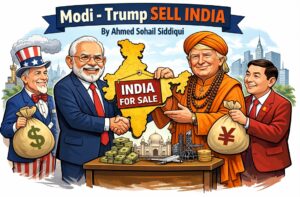
 MODI–TRUMP SELL INDIA
How Corporate Power, Unequal Trade, and Political Alignment Undermined Indian Sovereignty

Author: Ahmed Sohail Siddiqui
Senior Journalist & Editor
(www.HudaTaha.com)
BOOK POSITIONING (VERY IMPORTANT)
This book is:
Investigative, not theological
Policy-driven, not personality-driven
Evidence-based, not conspiratorial
Written to withstand legal scrutiny
Designed for India, global South, and international readers
********
CHAPTER 1
The Age of Captured Democracies
Democracy in the 21st century did not collapse through coups or invasions. It was quietly hollowed out—contracted by contract, policy by policy, election by election—until citizens retained the right to vote but lost the power to decide.
Across continents, governments continued to change, parliaments continued to sit, and constitutions remained formally intact. Yet economic decisions increasingly moved beyond public scrutiny into closed rooms occupied by corporate lobbyists, financial institutions, and strategic partners whose interests rarely aligned with those of ordinary citizens.
India was not immune to this global transformation. In fact, it became one of its most significant laboratories.
The capture of democracy does not require dictatorship. It requires alignment—between political leadership, global capital, and strategic power blocks. Once aligned, dissent is rebranded as anti-national, accountability is framed as obstruction, and sovereignty is reduced to symbolism.
This book examines how that alignment unfolded in India after 2014, particularly through economic policy, trade agreements, and strategic partnerships—most notably with the United States during the Trump era.
The question is not whether leaders were patriotic in intent. The question is whether outcomes served the nation or external and corporate interests.
CHAPTER 2
From Scandals to Silence: How Elites Escape Accountability
Modern power does not fear scandal. It has learned to survive.
Over the last three decades, repeated global scandals—financial crashes, intelligence failures, corporate frauds, and elite criminal cases—have followed a predictable pattern: outrage, investigation, selective accountability, and eventual silence.
What is striking is not that crimes occurred, but that systems failed uniformly across countries. Prosecutors hesitated. Media narratives fragmented. Political leaders deflected. Institutions protected themselves.
This pattern reveals an uncomfortable truth: accountability collapses not because evidence is absent, but because consequences are inconvenient.
Elite protection operates through:
- Legal complexity
- Jurisdictional confusion
- Media fatigue
- Political polarization
In India, this translated into a shrinking space for economic critique. Questions about trade terms, tax policy, or corporate favoritism were dismissed as ideological attacks rather than examined as governance issues.
Silence became policy.
CHAPTER 3
Trade Without Consent: How Nations Are Sold Through Agreements
Trade agreements today are rarely debated in public language. They are negotiated in technical jargon, buried in annexures, and passed off as inevitabilities of globalization.
Yet trade is not neutral.
1. When tariffs are lowered, someone loses protection.
2. When corporate taxes fall, someone else compensates.
3. When markets open, domestic producers face global giants without equal support.
In India’s case, post-2014 trade alignment emphasized:
- Foreign investment facilitation
- Corporate tax reduction
- Strategic concessions in technology, defense, and data
Meanwhile:
- Farmers faced import pressure
- Small manufacturers lost pricing power
- Consumers paid indirect taxes at historic levels
This was not accidental. It was a policy.
The Trump–Modi phase intensified this model under the banner of strategic friendship—while economic asymmetry deepened.
Trade without consent is not free trade. It is *managed extraction* .
CHAPTER 4
2014: The Economic Reset That Redefined Indian Sovereignty
The general election of 2014 was presented to the Indian public as a civilizational turning point. The language was emotional, the promises expansive, and the expectations unprecedented. Voters were told that corruption would end, black money would return, jobs would multiply, and India would reclaim its lost greatness.
What followed was indeed a reset—but not the one most citizens imagined.
The year 2014 marked the beginning of a fundamental shift in how the Indian state understood its relationship with capital, citizens, and sovereignty. This shift was neither accidental nor improvised. It reflected a conscious move toward a corporate-aligned governance model, deeply integrated with global capital flows and strategic Western partnerships.
The reset did not dismantle the old system. It replaced political patronage with corporate patronage, opacity with technical complexity, and electoral rhetoric with policy insulation.
The Promise vs the Blueprint
The electoral promise of 2014 focused on:
- Ending corruption
- Strengthening domestic production
- Empowering the poor and middle class
- Restoring national pride
The governing blueprint that followed prioritised:
- Rapid integration with global capital
- Investor confidence over citizen protection
- Deregulation and privatization
- Strategic alignment with US-led economic architecture
PREFACE
This book was not written in safety.
It was written in warning.
The arguments, evidence, and apprehensions documented in MODI–TRUMP SELL INDIA were first articulated in public view in 2013–14, when the author contested the 2014 Lok Sabha elections from Varanasi as an Independent candidate against Narendra Modi. At that time, these warnings were dismissed as exaggeration, paranoia, or political hostility. What followed in the years after was not debate—but erasure.
Between 2010 and 2016, the author published over 2,000 investigative articles in English on the website www.bismillahnewschannel.com , examining corporate-state convergence, media monopolization, communal polarization as political technology, and the shrinking space for dissent. That digital archive—built over years—was wiped off the web. No judicial order. No transparent explanation. No right of recovery.

Last Week , YouTube removed the Bismillah News Channel and Huda Taha Islamic Channel, platforms that had existed for over 16 years & 2 yrs respectively, accusing them of “promoting dangerous organisations”—an allegation so implausible that it collapses under minimal scrutiny. These channels had survived multiple policy cycles, audits, and algorithm changes. Their removal coincided precisely with renewed documentation of corporate narratives, ideological laundering, and transnational political alignment.
This pattern was not isolated.
Earlier websites, complaint records, and digital traces were similarly erased. Repeated complaints to statutory authorities were filed. Each time, they were suppressed, stalled, or neutralized—often, as later confirmed by insiders, through intervention at PMO-linked levels. Simultaneously, the author received hundreds of blank calls, a known intimidation technique, accompanied by indirect warnings to cease writing.
This book exists because those erasures failed.
When archives are destroyed, memory must be rebuilt.
When speech is silenced, documentation must harden.
MODI–TRUMP SELL INDIA is not a slogan. It is an inquiry into how economic sovereignty, democratic accountability, and policy autonomy were incrementally traded—through spectacle, alignment, and manufactured consent.
This is not a book against India.
It is a book against forgetting.
AUTHOR’S INTRODUCTION
Why These Warnings Were Written Before Power Was Secured
I began writing this book long before it had a title.
In 2013–14, as India prepared for what was projected as a decisive electoral shift, I wrote a series of articles in English warning that the projected “strong leadership” model carried structural dangers:
- the fusion of corporate capital with executive authority
- the weakening of parliamentary oversight
- the conversion of nationalism into economic insulation for elites
- and the reframing of dissent as disloyalty
These were not retrospective insights. They were pre-emptive warnings.
I contested the 2014 elections from Varanasi not with the illusion of victory, but with the obligation of record. Electoral participation was a method of placing dissent inside the democratic archive—so that what followed could never be said to have gone unchallenged.
What followed instead was not engagement, but disappearance.
My digital platforms were erased. My journalism was delegitimized not through rebuttal, but through deletion. My speech was not answered—it was algorithmically buried, legally stalled, and administratively neutralized.
This experience taught me something essential:
> In contemporary democracies, censorship does not always announce itself.
It often arrives disguised as policy enforcement, platform hygiene, or national interest.
The Pattern This Book Documents
This book examines a convergence—not a conspiracy.
It documents how:
Corporate capital gained unprecedented policy proximity
Media ecosystems transformed from watchdogs into amplifiers
Foreign alignment, particularly with U.S. power centers under Trump-era transactionalism, reshaped domestic economic choices
Public consent was engineered through identity narratives rather than economic disclosure
The Modi–Trump relationship is examined here not as personality politics, but as symbolic synchronization—where optics substituted for transparency, and alignment was presented as inevitability.
Why Erasure Matters to the Argument
My platforms were not removed because they were irrelevant.
They were removed because they were inconvenient.
When over 2,000 articles, 16 years of video archives, and multiple websites vanish without judicial accountability, the issue is no longer personal—it becomes constitutional.
A democracy that cannot tolerate documentation cannot claim confidence.
Books Written Against Silence
This work stands alongside other ongoing and forthcoming books, each addressing a different fracture created by the same structural forces:
1. INK AGAINST ERASURE – documenting censorship, digital wiping, and narrative control
2. I DENY – exposing fabrications and ideological laundering in “I Witness” by Shahid Siddiqui
3. FIXED FIGHT: Modi–Owaisi Symbiosis – examining managed opposition and political containment
4. FRACTURED UNITY – analyzing the Shia–Sunni divide as a geopolitical and intelligence tool
5. MODI–TRUMP SELL INDIA – the present work, focusing on sovereignty, economics, and alignment
Together, these books form a single archive: resistance through record.
—
A Final Word to the Reader
I did not write this because it was safe.
I wrote it because silence had become dangerous.
If democracies survive, they do so not through obedience—but through memory.
This book is memory, restored.
— Ahmed Sohail Siddiqui
This divergence was not openly debated. It was executed administratively.
Corporate Tax as Policy Signal
One of the earliest and clearest indicators of the new economic direction was the systematic reduction of corporate tax burdens.
Between 2014 and 2019:
Corporate tax rates were reduced
Effective tax liabilities fell further due to exemptions
Large corporations received write-offs, restructurings, and incentives
This was justified as necessary to:
Attract foreign investment
Boost manufacturing
Improve ease of doing business rankings
However, the burden did not disappear. It shifted.
Indirect taxation—especially through GST—expanded dramatically. Consumption taxes became the backbone of state revenue, disproportionately impacting:
- The poor
- Small traders
- Farmers
- Informal sector workers
- In effect, citizens subsidized corporate competitiveness.
- The Myth of Trickle-Down Nationalism
Economic policy was wrapped in nationalist rhetoric. Corporate growth was equated with national strength. Questioning policy was framed as questioning the nation.
Yet data told a different story:
- Job creation lagged behind population growth
- Informal employment expanded
- Farmer incomes stagnated
- Wealth concentration increased
- Nationalism became a shield for policy choices that would otherwise face resistance.
This was not unique to India—but India executed it with exceptional political discipline and media management.
Strategic Alignment as Economic Leverage
Post-2014 India aggressively pursued strategic alignment with the United States and its allies. Defense deals, technology partnerships, and diplomatic optics dominated headlines.
- What received less attention were the economic asymmetries embedded in these alignments:
- Defense purchases with limited technology transfer
- Data and digital market concessions
- Trade negotiations skewed toward foreign corporate access
The promise of strategic elevation masked the reality of economic dependency.
India was not being conquered. It was being integrated—on unequal terms.
Farmers Outside the Frame
Perhaps the most telling omission the post-2014 economic reset was the marginalization of farmers from the national economic imagination.
Agriculture was discussed rhetorically but treated administratively:
Input costs rose
Import exposure increased
MSP protections weakened in practice
Corporate entry into agriculture accelerated
Farmers were expected to absorb global volatility without global protections.
The result was predictable:
Protests
Distress
Debt
Suicides
Yet the policy direction remained unchanged.
Sovereignty Redefined
Sovereignty in the post-2014 framework was no longer about:
Economic self-determination
Policy autonomy
Protection of vulnerable sectors
It was redefined as:
Strategic alignment
Military symbolism
Diplomatic visibility
Economic sovereignty became secondary to geopolitical branding.
The Silence of Institutions
Parliamentary debate narrowed. Independent institutions faced pressure. Media consolidation intensified.
Economic critique became risky—not legally, but professionally and socially.
Silence was not enforced by law alone. It was cultivated through:
Polarization
Selective outrage
Narrative fatigue
By the time consequences became visible, policy pathways were already locked in.
The Reset Completed
By the end of the first term, the reset was complete:
Corporate power entrenched
Citizen burden normalized
Dissent delegitimised
Global alignment irreversible
India had not lost its flag, anthem, or elections.
It had lost economic choice.
This chapter is not an indictment of intent. It is an examination of outcomes. History does not judge slogans. It judges structures.
The chapters that follow will examine how this reset unfolded sector by sector—and who paid its price.
To be continued
**”***