
MODI–TRUMP SELL INDIA – 3 – By Ahmed Sohail Siddiqui -Strategic Friendship or Strategic Surrender ?
MODI–TRUMP SELL INDIA – 4 – By Ahmed Sohail Siddiqui –
Can Sovereignty Be Reclaimed ?
CHAPTER 13
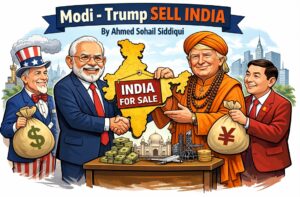 Can Sovereignty Be Reclaimed ?
Sovereignty, once diluted, is rarely restored through slogans. It is reclaimed through policy redesign, institutional courage, and democratic insistence. The question confronting India is not whether sovereignty has been compromised—that evidence has been laid out—but whether reversal is still possible within constitutional and democratic frameworks.
This chapter argues that it is—but only if myths are abandoned and costs are confronted honestly.
Sovereignty Is Not Isolation
Reclaiming sovereignty does not mean rejecting globalization or retreating from international engagement. It means renegotiating terms, restoring balance, and rebuilding domestic capacity.
Countries that retain sovereignty do not avoid markets. They:
Regulate them
Sequence integration
Protect strategic sectors
India once understood this distinction. It can again.
The Myth of No Alternatives
The most damaging narrative of the last decade has been inevitability.
Citizens were told:
Capital has no alternatives
Trade terms are non-negotiable
Corporate concessions are compulsory
Global alignment is irreversible
None of this is true.
Policy space shrinks only when governments choose not to use it.
Reclaiming Economic Choice
Sovereignty begins with restoring choice.
This requires:
Revisiting tax equity
Rebalancing direct and indirect taxation
Redesigning incentives toward employment, not scale alone
Growth must be measured not only by GDP—but by distribution and durability.
Re-centering Agriculture
No nation with a large agrarian base can afford to marginalize farmers.
Reclaiming sovereignty demands:
Guaranteed income stability
Predictable procurement
Protection from subsidized imports
Farmer participation in reform design
Food security is national security.
Rebuilding Domestic Enterprise
Foreign capital should complement—not replace—domestic capacity.
This means:
Prioritizing SMEs
Ensuring credit access
Reducing compliance asymmetry
Linking incentives to domestic value addition
Production rooted locally sustains sovereignty globally.
Technology With Transfer
Strategic partnerships must be renegotiated around:
Technology transfer
Domestic manufacturing
Skill integration
Procurement without production is dependence.
Alignment without autonomy is submission.
Data as National Infrastructure
Data policy must be treated as infrastructure—not commodity.
This requires:
Sovereign regulatory frameworks
Domestic platform protection
Clear limits on cross-border exploitation
Future power will be digital—or it will not be national.
Media and Institutional Renewal
Economic sovereignty cannot survive without narrative sovereignty.
This demands:
Independent journalism
Transparent institutions
Parliamentary centrality
Debate is not disruption. It is correction.
Democracy as Leverage
Democracy remains India’s greatest strength—if exercised fully.
Reclaiming sovereignty requires citizens to:
Demand policy clarity
Reject inevitability narratives
Insist on reversibility
Votes must translate into leverage—not just legitimacy.
The Cost of Reversal
Reclaiming sovereignty is not painless.
It will:
Displease capital
Invite pressure
Require redistribution
But the cost of non-reversal is greater: permanent dependency.
A Choice Still Exists
History does not move in straight lines.
The structures built post-2014 are powerful—but not immutable.
Sovereignty, once recognized as compromised, can still be reclaimed—if citizens insist and institutions respond.
Toward the Conclusion
The final chapter will not offer slogans or enemies. It will offer a reckoning—what this period means for India’s future, and what responsibility history assigns to power.
********
CHAPTER 14
The Road Ahead for India
Every historical phase ends not with certainty, but with consequence. The period examined in this book will eventually be debated, defended, and reinterpreted—but its outcomes will endure long after its rhetoric fades.
This concluding chapter is not about blame. It is about responsibility.
What This Period Will Be Remembered For
History rarely remembers slogans. It remembers structures.
This era will be judged by:
The redistribution of economic burden
The concentration of power
The narrowing of policy choice
The redefinition of sovereignty
Intentions will matter less than outcomes.
India did not cease to exist as a democracy. It evolved into a system where economic decisions drifted away from popular control, even as political participation remained high.
That contradiction will define its legacy.
The Danger of Normalization
The most lasting damage inflicted by any political-economic phase is normalization.
When:
Inequality becomes acceptable
Farmer distress becomes routine
Citizen burden becomes expected
Policy insulation becomes standard
Correction becomes harder.
This book has argued that the greatest risk India faces is not collapse—but permanent adjustment to diminished sovereignty.
Power Without Accountability Is Temporary
All power systems that insulate themselves from accountability eventually weaken from within.
Economic growth detached from social legitimacy does not endure. Strategic alignment without public consent does not stabilize. Democracy without choice does not inspire loyalty.
India’s strength has always been its capacity for correction.
That capacity must not be surrendered.
The Role of Future Leadership
The responsibility now shifts to those who govern next.
They will inherit:
Locked-in trade frameworks
Concentrated corporate power
Fractured public trust
Constrained policy space
Leadership will be tested not by alignment—but by renegotiation.
The courage to revisit decisions will matter more than the courage to make new ones.
The Role of Institutions
Institutions must rediscover their purpose.
Parliament must debate substance, not symbolism.
Regulators must regulate, not defer.
Media must question, not amplify.
Institutions do not defend sovereignty through loyalty—but through independence.
The Role of Citizens
Ultimately, sovereignty does not belong to governments. It belongs to citizens.
Citizens reclaim sovereignty when they:
Refuse inevitability narratives
Demand transparency
Insist on reversibility
Protect democratic friction
Democracy works only when citizens expect more than ritual.
What This Book Asks of the Reader
This book does not ask for agreement.
It asks for scrutiny.
It does not offer heroes or villains.
It offers structures and consequences.
If it succeeds, it will do so by restoring a simple idea to public debate:
Economic policy is not fate. It is choice.
A Final Reckoning
India stands at neither the end nor the beginning—but at a crossroads.
One path leads to deeper integration without insulation, growth without equity, alignment without autonomy.
The other demands recalibration, resistance to inevitability, and the courage to rebalance power.
History will not ask which path was easier.
It will ask which path preserved dignity, resilience, and choice.
Author’s Note
This book is written not in opposition to India—but in defense of its democratic promise.
Critique is not disloyalty.
Silence is.
END OF CORE MANUSCRIPT
MODI–TRUMP SELL INDIA
By Ahmed Sohail Siddiqui
********