
*MODI–TRUMP SELL INDIA – 2 – By Ahmed Sohail Siddiqui*
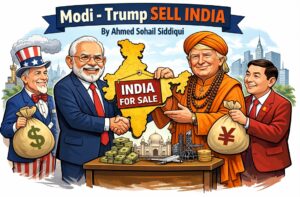 MODI–TRUMP SELL INDIA – 3 – By Ahmed Sohail Siddiqui –
CHAPTER 9
Strategic Friendship or Strategic Surrender ?
Strategic partnerships are judged not by handshakes or stage optics, but by the balance of concessions embedded within them. Friendship between nations, when unequal in power and leverage, often masks asymmetry beneath ceremony.
The Modi–Trump phase of India–US relations was presented as a historic elevation—two strong leaders, two large democracies, aligned against common threats. Public spectacle dominated the narrative. Policy detail remained largely out of frame.
This chapter examines whether that alignment strengthened India’s sovereignty—or constrained it.
The Optics of Equality
Mass rallies, mutual praise, and symbolic gestures created the impression of parity. The language was personal: chemistry, friendship, trust.
Yet international relations do not operate on chemistry. They operate on:
Market access
Defense procurement
Regulatory alignment
Strategic concessions
Optics can disguise imbalance—but they cannot erase it.
Trade Without Reciprocity
Trade negotiations during this period revealed a persistent asymmetry.
The United States pressed India on:
Market access
Tariff reductions
Agricultural imports
Digital trade rules
India sought:
Visa flexibility
Export concessions
Technology access
Outcomes consistently favored US corporate interests. Indian concessions were concrete. Indian gains were conditional and reversible.
Strategic friendship did not translate into trade equity.
Defense Deals as Dependence
Defense cooperation expanded rapidly. High-value procurements were celebrated as symbols of trust.
However:
Technology transfer remained limited
Indigenous manufacturing lagged
Long-term maintenance dependencies increased
Defense imports create strategic lock-in. They bind future policy choices.
Security partnership, when procurement-heavy and transfer-light, deepens dependence.
Data, Digital Markets, and Control
Digital trade emerged as a quiet but critical frontier.
US corporations sought:
Open data flows
Regulatory flexibility
Market dominance
India faced pressure to align with global digital frameworks shaped elsewhere.
Control over data is Control over future economies. Concessions here carry generational consequences.
Sanctions and Selective Sovereignty
Strategic alignment also meant navigating US sanctions regimes.
India found itself:
Seeking waivers
Adjusting purchases
Explaining sovereign decisions
A sovereign nation requesting exemptions reveals the limits of autonomy.
Alignment reduced maneuvering space.
The Cost of Strategic Loyalty
Strategic loyalty demands consistency—even when domestic costs rise.
India absorbed:
Trade pressure
Diplomatic expectations
Policy alignment costs
Without commensurate safeguards.
Partnership became obligation.
The Silence Around Terms
Few of these arrangements were debated publicly. Details remained dispersed across announcements, memoranda, and executive decisions.
Parliamentary scrutiny was limited. Media focus remained on symbolism.
Citizens were asked to trust—not to evaluate.
Personality Politics vs Structural Reality
The focus on leaders obscured structures.
Trump was transactional. Modi was strategic. But systems outlast personalities.
What mattered were the precedents set:
Market openness without reciprocity
Procurement without production
Alignment without insulation
These precedents endure.
Friendship Tested by Change
When leadership changed in Washington, the asymmetry remained. This exposed the illusion that personal rapport drives national interest.
India’s concessions were institutional. Benefits were situational.
The Central Question
Strategic partnership is not inherently harmful. The question is balance.
Did India gain:
Policy autonomy?
Economic leverage?
Strategic flexibility?
Or did it exchange these for visibility and alignment?
The evidence suggests a narrowing of choice.
The next chapter examines specific domains—trade, defense, and data—where this narrowing became irreversible.
********
CHAPTER 10
Trade, Defense, and Data: What India Gave Up
Strategic alignment is never abstract. It is encoded in agreements, procurement decisions, regulatory changes, and policy commitments that shape a nation’s future long after political headlines fade. During the Modi–Trump phase, three domains reveal the true cost of alignment more clearly than any speech: trade, defense, and data.
Each tells a consistent story—not of collapse, but of constrained choice.
Trade: Concessions Without Symmetry
Trade negotiations between India and the United States during this period were marked by persistent imbalance.
India was pressed to:
Reduce tariffs
Open sensitive sectors
Ease regulatory barriers
The United States, meanwhile, retained:
Agricultural subsidies
Protectionist safeguards
Discretionary market access
Indian exporters faced uncertainty. US corporations secured predictability.
Trade is leverage. India surrendered portions of it without securing structural reciprocity.
Agriculture as a Bargaining Chip
Agriculture repeatedly surfaced as a pressure point.
The US sought:
Access for subsidized agricultural products
Reduced sanitary and phytosanitary barriers
Greater corporate entry
India resisted publicly—but adjusted quietly.
Even marginal concessions in agriculture have outsized impact in a country where livelihoods depend on price stability.
Farmers bore risks they never negotiated.
Defense: Procurement Over Production
Defense cooperation expanded rapidly—but the nature of that expansion mattered.
High-value imports:
Strengthened short-term capability
Increased long-term dependency
Technology transfer remained limited. Indigenous production lagged behind announcements.
Defense procurement without production integration creates strategic reliance—not strategic autonomy.
The security narrative masked economic consequence.
Maintenance as Leverage
Modern defense systems are not one-time purchases. They require:
Continuous maintenance
Software updates
Spare parts
Training
These dependencies extend influence beyond contracts.
Sovereignty erodes not at purchase—but in perpetuity.
Data: The Quiet Frontier
Data became the most consequential—and least debated—domain.
US corporations pushed for:
Unrestricted data flows
Regulatory flexibility
Market dominance
India faced pressure to align digital policy with global norms shaped by corporate interests.
Data governs:
Artificial intelligence
Financial systems
Citizen behavior
National security
Control here defines future power.
Concessions made quietly echo loudly later.
Digital Markets Without Digital Power
India opened markets faster than it built domestic platforms.
Foreign firms gained scale. Indian startups faced consolidation pressure.
Market access without ecosystem protection creates dependency—not innovation.
Regulatory Harmonization as Surrender
Alignment often arrived disguised as harmonization.
Standards were adjusted. Rules softened. Oversight diluted.
Harmonization simplifies trade—but can hollow sovereignty when standards are set elsewhere.
The Cost of Predictability
Investors value predictability. Citizens value protection.
Policy increasingly prioritised the former.
When predictability is purchased through irreversible commitments, democratic correction becomes difficult.
What Was Not Gained
Despite alignment, India did not secure:
Guaranteed technology transfer
Fair trade access
Employment-intensive investment
Policy insulation
Strategic rhetoric outpaced strategic returns.
The Accumulated Effect
Each concession seemed manageable. Together, they formed a pattern:
Reduced maneuvering space
Increased dependency
Narrowed future choices
India did not lose sovereignty overnight. It traded flexibility for alignment.
The Question History Will Ask
Strategic partnerships should expand options—not constrain them.
Did this alignment leave India stronger in decision-making—or merely louder in symbolism?
The next chapter answers that by mapping outcomes—who gained, who paid, and who was left carrying the cost.
********
CHAPTER 11
Who Benefited, Who Paid
Every economic model produces winners and losers. When governments avoid naming them, inequality becomes invisible and accountability evaporates. The Modi–Trump alignment, embedded within a broader corporate-first economic framework, followed this rule with precision.
The question is not whether growth occurred.
The question is who captured it—and who absorbed its costs.
The Primary Beneficiaries: Concentrated Power
The most visible beneficiaries were:
Large domestic conglomerates
Multinational corporations
Financial markets
Upper segments of asset-owning classes
These actors gained from:
Tax reductions
Regulatory relaxation
Market access
Policy predictability
Their balance sheets expanded. Their leverage increased.
Growth clustered at the top.
Corporate India’s Expansion
A small number of corporate houses experienced unprecedented consolidation:
Expanded across sectors
Increased market share
Accessed cheaper capital
Absorbed distressed assets
State policy facilitated scale. Competition narrowed.
Corporate success was framed as national success—blurring private gain and public interest.
Foreign Corporations: Market Without Risk
Foreign firms accessed:
One of the world’s largest consumer markets
Policy stability
Regulatory accommodation
Without assuming:
Social responsibility
Employment proportionality
Long-term developmental obligation
Profit repatriation flowed outward. Risk remained domestic.
Financial Markets: Wealth Without Work
Stock markets surged even as employment stagnated.
Financialization rewarded:
Speculation
Capital mobility
Asset ownership
It penalized:
Labor
Production
Informal enterprise
This disconnect deepened public alienation from “growth.”
The Cost Bearers: The Silent Majority
Those who paid were neither invisible nor accidental.
They included:
Farmers facing volatile prices
Small traders burdened by compliance
Workers confronting job insecurity
Consumers funding the state through indirect taxes
They paid daily, incrementally, and without negotiation.
The Middle Class Squeeze
The middle class absorbed:
Rising living costs
Stagnant incomes
Increased taxation
Reduced social security
They were told they were nation-builders—while functioning as revenue buffers.
Aspiration replaced security.
Youth Without Opportunity
India’s youth entered a labor market marked by:
Contractualization
Informality
Automation
Credential inflation
Education no longer guaranteed mobility. Employment no longer ensured stability.
Demographic advantage risked becoming demographic pressure.
Farmers as Shock Absorbers
Farmers continued to:
Feed the nation
Stabilize prices
Absorb global volatility
Without commensurate protection.
They were expected to endure silently—for the greater good.
Inequality as Policy Outcome
Inequality did not rise accidentally.
It emerged from:
Tax design
Market exposure
Capital prioritization
Policy insulation
The system functioned exactly as structured.
Redistribution Without Recognition
The state redistributed the burden downward—without acknowledging it as redistribution.
This avoided political accountability while sustaining fiscal balance.
The Illusion of Shared Sacrifice
Sacrifice was uneven—but framed as a collective.
Those with the least capacity bore the greatest weight.
Those with the most influence escaped scrutiny.
The Balance Sheet of Alignment
When benefits and costs are tallied:
Power concentrated
Risk socialized
Choice narrowed
India did not collapse. It recalibrated—in favor of capital.
The Final Question Before the End
Was this outcome inevitable? Or was it chosen?
The final chapters confront the most difficult issue of all—not what happened, but whether it can be reversed.
********
CHAPTER 12
Democracy Without Choice
Democracy is often measured by its rituals: elections held, votes counted, governments changed. Yet the deeper measure of democracy lies elsewhere—in whether citizens retain meaningful choices over the policies that govern their lives.
In post-2014 India, democratic form endured. Democratic substance narrowed.
This chapter examines how a nation can remain electorally vibrant while becoming economically constrained.
The Shrinking Policy Spectrum
As economic alignment deepened, the range of acceptable policy debate contracted.
Across political divides, certain assumptions became untouchable:
Corporate tax competitiveness
Foreign capital dependence
Market-led reform
Strategic alignment frameworks
Elections changed leaders. They did not change direction.
Democracy persisted—but without alternatives.
Consent Without Deliberation
Consent is meaningful only when informed and reversible.
Major economic decisions during this period:
Were implemented through executive action
Avoided sustained parliamentary scrutiny
Were framed as inevitabilities
Citizens were asked to endorse outcomes—not evaluate options.
Democracy became retrospective approval.
The Voter as Symbol, Not Stakeholder
Political campaigns mobilized identity, emotion, and symbolism.
Economic governance remained insulated.
Voters were courted for legitimacy—but excluded from policy design.
Participation did not equal influence.
Institutions Under Pressure
Independent institutions did not disappear. Their autonomy eroded gradually.
Regulatory bodies:
Became cautious
Avoided confrontation
Deferred to executive priorities
Checks remained on paper. Balance shifted in practice.
Media and the Feedback Loop
Without sustained economic scrutiny, feedback weakened.
Policy mistakes persisted longer. Corrections arrived late.
Democracy depends on friction. Silence reduces friction.
The Paradox of Popular Mandate
Strong mandates were interpreted as blank cheques.
Electoral victory was used to justify:
Structural shifts
Irreversible commitments
Long-term constraints
Mandate replaced accountability.
Choice Without Consequence
Citizens could change representatives—but not renegotiate contracts, tax structures, or trade frameworks already locked in.
Democracy without reversibility is democracy without leverage.
The Normalization of Power Asymmetry
As inequality widened, political influence followed wealth.
Campaign finance, media access, and policy reach increasingly mirrored economic power.
Formal equality masked functional disparity.
Democratic Fatigue
When elections fail to alter lived outcomes, citizens disengage—or polarize.
Both weaken democracy.
Fatigue is not apathy. It is learned futility.
A System That Stabilized Itself
By this stage, the system had achieved equilibrium:
Capital confidence sustained
Citizen burden normalized
Debate constrained
Stability replaced justice as the governing metric.
The Central Warning
Democracy does not collapse loudly. It erodes quietly.
It survives as a ritual while surrendering substance.
India did not lose its vote.
It risked losing its voice over economic destiny.
Where This Leaves Us
This book has traced:
How alignment narrowed options
How policy insulated itself
How democracy endured without choice
The final chapters confront the hardest question of all:
Is this trajectory irreversible—or can sovereignty be reclaimed within democratic frameworks ?
Contd…
********