
**MODI–TRUMP SELL INDIA – By Ahmed Sohail Siddiqui*
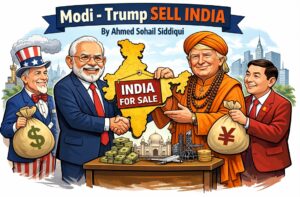
*MODI–TRUMP SELL INDIA – 2 – By Ahmed Sohail Siddiqui*

CHAPTER 5
Corporate Tax Holidays, Citizen Tax Burdens
Tax policy is the clearest expression of a government’s priorities. It reveals—more honestly than speeches—who is protected, who is burdened, and who is expected to remain silent.
In post-2014 India, taxation was not merely reformed; it was rebalanced. The direction of this rebalancing explains much of the economic distress that followed.
The Corporate Tax Turn
One of the most celebrated economic decisions of the Modi government was the sharp reduction in corporate tax rates. In 2019, the headline corporate tax rate was slashed, positioning India as one of the most “competitive” investment destinations among emerging economies.
The justification was familiar:
- Corporations would invest more
- Jobs would be created
- Growth would accelerate
- Revenue losses would be temporary
This narrative was presented as economic common sense. What was not debated adequately was who would fill the resulting fiscal gap.
Effective Tax vs Headline Tax
Corporate taxation does not operate on headline rates alone. Through exemptions, incentives, depreciation benefits, and restructuring mechanisms, large corporations often pay far less than advertised.
Multiple studies and parliamentary disclosures revealed that:
- Large firms benefited disproportionately from exemptions
- Write-offs and loan restructurings shielded balance sheets
- Tax disputes involving major corporates remained unresolved for years
The system did not collapse. It adjusted—by shifting the burden elsewhere.
The Rise of Indirect Taxation
As direct corporate tax revenues declined, the Indian state leaned heavily on indirect taxation—particularly the Goods and Services Tax (GST).
GST was promoted as a unifying reform. In practice, it became a regressive revenue engine.
Indirect taxes:
- Are paid equally by rich and poor
- Do not account for income disparity
- Fall hardest on consumption
For millions of Indians, this meant:
- Higher prices on essentials
- Increased compliance burden for small traders
- Reduced margins for informal businesses
The state’s dependence on consumption-based taxation grew—locking citizens into a permanent revenue role.
The Informal Sector Pays the Price
India’s economy has long depended on its informal sector: small traders, artisans, daily wage earners, and micro-entrepreneurs.
Post-2014 tax restructuring disproportionately affected this sector:
- Compliance complexity increased
- Cash flow pressures intensified
- Credit access tightened
While large corporations hired consultants and absorbed shocks, small businesses faced survival decisions.
This was not collateral damage. It was a policy trade-off.
Citizens as Revenue Stabilizers
The Indian citizen became the stabilizer of state finances.
When corporate tax revenues dipped:
- Fuel taxes rose
- Consumption taxes expanded
- Fees and penalties increased
Petroleum taxation, in particular, became a silent extractor. Despite falling global crude prices at various points, domestic fuel prices remained high—functioning as a quasi-tax on mobility and productivity.
Citizens paid daily. Corporations negotiated annually.
Investment Without Employment
The central promise of corporate tax reduction was job creation. Yet employment data failed to match expectations.
Investment increased selectively:
- Capital-intensive sectors
- Automation-driven industries
- Financial markets
Employment growth remained sluggish, especially for youth.
The result was a paradox:
- Rising stock indices
- Rising unemployment
- Rising inequality
Growth existed—but it was jobless and concentrated.
Wealth Concentration Accelerates
Tax policy shapes wealth distribution. In the post-2014 period:
- Wealth concentration increased
- Top corporate houses expanded rapidly
- Middle-class purchasing power stagnated
The gap between corporate profitability and citizen wellbeing widened.
This was not an unintended consequence. It was the mathematical outcome of policy design.
The Silence Around Fairness
Public debate on tax fairness diminished. Discussions focused on:
- Ease of doing business
- Global competitiveness
- Investor sentiment
Rarely did the conversation ask:
- Who pays more now than before?
- Who pays less—and why?
- What social costs are being absorbed silently?
Economic nationalism did not translate into economic equity.
A Structural Shift, Not a Temporary Phase
Supporters argued that short-term pain was necessary for long-term gain. Years later, the structure remained unchanged.
Once tax policy privileges capital over citizens, reversal becomes politically costly. Corporations gain leverage. Citizens lose bargaining power.
The tax system becomes locked in.
The Core Question
This chapter does not argue against investment or enterprise. It raises a simpler question:
Should national growth be financed by those with the least capacity to pay?
In post-2014 India, the answer—revealed through tax design—was unmistakable.
The next chapter examines where this burden became most visible, most painful, and most politically explosive: India’s farmers.
********
CHAPTER 6
Farmers, Free Markets, and the Fiction of Reform
No sector reveals the moral core of an economic model more clearly than agriculture. In India, farming is not merely an occupation; it is the foundation of social stability, food security, and political legitimacy. Any reform that destabilizes this foundation risks consequences far beyond economics.
Post-2014 agricultural policy was framed as reformist, modern, and farmer-friendly. In practice, it exposed farmers to market forces without providing them the protections that market economies elsewhere consider non-negotiable.
The Language of Reform
The word “reform” was deployed with deliberate ambiguity. It suggested efficiency, freedom, and progress—without specifying for whom.
Agricultural reform rhetoric emphasized:
- Market freedom
- Private investment
- Supply-chain efficiency
- Reduced state intervention
These ideas were not inherently flawed. The problem lay in selective application.
Markets Without Safeguards
In advanced economies, free agricultural markets coexist with:
- Heavy subsidies
- Guaranteed price mechanisms
- State-backed insurance
- Import controls
Indian farmers were offered markets without these safeguards.
Minimum Support Price (MSP) remained in theory but weakened in practice. Procurement became inconsistent. Market exposure increased—while farmer risk skyrocketed.
The state stepped back. Corporations stepped in.
Corporate Entry and Farmer Exit
Policy changes encouraged corporate participation in:
- Storage
- Procurement
- Logistics
- Contract farming
This was presented as efficiency enhancement. What was less discussed was bargaining asymmetry.
Corporations negotiate at scale. Farmers negotiate individually.
The imbalance was structural. Contracts favored capital. Risk was transferred downward.
The Global Price Trap
India’s farmers were increasingly linked to global price movements without the cushions available to their counterparts in the US or EU.
When global prices fell:
- Imports undercut domestic produce
- Farmer incomes collapsed
When prices rose:
- Consumers paid more
- Farmers saw little benefit due to intermediaries
Farmers absorbed volatility from both ends.
Rising Costs, Stagnant Returns
While output prices remained uncertain, input costs surged:
- Seeds
- Fertilizers
- Diesel
- Electricity
Subsidies failed to keep pace. Credit access tightened. Debt deepened.
Farming became a gamble where the odds were stacked against the cultivator.
Protest as Policy Feedback
The farmers’ protests that erupted were not spontaneous or politically manufactured. They were the cumulative response to years of economic pressure.
Protesters were dismissed as misinformed, manipulated, or anti-national. Rarely were they treated as stakeholders raising legitimate concerns.
The state listened—but did not internalize.
The Moral Hazard of Food Security
India’s food security system depends on farmers continuing to farm despite shrinking margins.
This creates a moral hazard:
- The nation relies on farmers’ resilience
- Policy relies on their silence
When silence breaks, the system labels it disruption.
Reform Without Representation
Perhaps the most troubling aspect of agricultural reform was the absence of meaningful farmer representation in policy formulation.
Consultations occurred—but decisions were pre-determined.
Reform became something done to farmers, not with them.
The Cost Beyond Numbers
Farmer distress is often reduced to statistics: income levels, productivity metrics, GDP contribution.
What remains unaccounted for:
- Mental health
- Social breakdown
- Generational despair
Farmer suicides are not economic data points. They are policy failures.
The Fiction Exposed
The fiction of reform lies in presenting market exposure as empowerment, while removing protection.
True reform would:
- Stabilize incomes
- Reduce risk
- Strengthen bargaining power
What occurred instead was exposure without defense.
The Larger Pattern
Agriculture was not an exception. It was an early indicator.
The same logic—withdraw protection, invite capital, normalize citizen burden—would soon be applied to other sectors.
Farmers were not resisting change. They were resisting abandonment.
The next chapter examines how foreign capital, celebrated as salvation, reshaped India’s economic priorities—often at the cost of domestic resilience.
********
Continuing cleanly, same measured A4 book voice, no slogans, no speculation—only structural analysis.
CHAPTER 7
Foreign Capital vs Domestic Survival
Foreign capital is often portrayed as neutral—an engine that arrives, invests, creates growth, and departs leaving prosperity behind. In reality, capital has preferences, conditions, and exit strategies. It does not serve nations; it serves returns.
Post-2014 India embraced foreign capital not as a supplement to domestic capacity, but increasingly as a substitute for it. This distinction is crucial.
The Courtship of Capital
India’s outreach to foreign investors was aggressive and unapologetic. Policy messaging emphasized:
- Predictability for investors
- Policy stability
- Regulatory relaxation
- Assurances against “policy shocks”
Investor roadshows replaced domestic consultations. Global perception became as important as local impact.
The implicit message was clear: capital comfort was a national priority.
Capital Is Not Loyalty
Foreign capital does not share the emotional or social stake that domestic enterprise often carries. It:
- Enters when margins are favorable
- Exits when conditions change
- Pressures governments through market signals
This is not a moral critique—it is a functional reality.
Yet policy frameworks increasingly treated foreign investment as a permanent partner rather than a transactional participant.
The Asymmetry of Power
Foreign investors arrive with:
- Legal teams
- International arbitration access
- Diplomatic leverage
- Mobility of funds
Domestic producers arrive with:
- Fixed assets
- Local labor
- Regulatory exposure
- Limited exit options
When policy tilts toward capital mobility, domestic survival weakens.
Manufacturing Without Roots
Manufacturing growth was projected as a flagship outcome of foreign investment-led growth.
In practice:
- Assembly increased more than deep manufacturing
- Technology transfer remained limited
- Supply chains stayed externally dependent
India became a node, not a nucleus.
Employment generation remained modest relative to capital inflow.
Financialization Over Production
A significant portion of foreign inflows entered:
- Financial markets
- Real estate
- Portfolio investments
These inflows:
- Boosted asset prices
- Increased volatility
- Benefited a narrow segment
Capital markets flourished. The real economy struggled.
The Currency Constraint
Foreign capital brings with it currency sensitivity.
Policy choices increasingly accounted for:
- Exchange rate stability
- Capital flight risks
- Global interest rate cycles
Domestic priorities were adjusted to reassure markets rather than address ground realities.
Economic sovereignty narrowed quietly.
Small and Medium Enterprises Left Behind
SMEs form the backbone of Indian employment. Yet policy alignment favored scale over spread.
Foreign-backed enterprises:
- Accessed cheaper capital
- Benefited from policy facilitation
- Navigated compliance with ease
SMEs faced:
- Credit constraints
- Compliance overload
- Market displacement
Survival became attrition.
The Illusion of Choice
India was repeatedly told it had no alternative—that global capital was inevitable, resistance impractical, and protection outdated.
This framing erased a key truth: countries choose how they integrate.
Integration is not surrender—unless it is unconditional.
Strategic Silence
Questions about:
- Profit repatriation
- Long-term dependency
- Domestic displacement
Were sidelined as pessimism.
Economic optimism became performative.
Capital Wins, Resilience Loses
The result of this imbalance was predictable:
- Growth without depth
- Investment without insulation
- Exposure without protection
Foreign capital did not destroy domestic capacity—but it outpaced it, out-leveraged it, and eventually overshadowed it.
The Pattern Emerges
Foreign capital, corporate tax shifts, agricultural exposure—these were not isolated decisions. They formed a coherent pattern.
A state increasingly optimized for:
- Capital confidence
- Global optics
- Strategic alignment
At the cost of:
- Domestic resilience
- Citizen security
- Economic autonomy
The next chapter examines the role of media and narrative management in sustaining this model—and why economic pain did not translate into political correction.
********
Continuing in the same disciplined A4 book style—analytical, restrained, and cumulative.
CHAPTER 8
Media, Silence, and Manufactured Nationalism
Economic transformation on this scale cannot survive on policy alone. It requires narrative management. In modern democracies, that task falls primarily to the media—not necessarily through overt censorship, but through selective amplification, distraction, and silence.
Post-2014 India witnessed a profound shift not only in policy direction, but in how economic reality was communicated to the public.
From Watchdog to Amplifier
Traditionally, media functions as a watchdog—scrutinizing power, interrogating policy, and amplifying public interest. In the post-2014 environment, large segments of the media ecosystem evolved into policy amplifiers.
Economic decisions were increasingly framed as:
- Bold
- Decisive
- Nationalistic
Critical questions were reframed as negativity. Structural critique was labeled obstruction.
The tone changed first. The content followed.
Ownership Shapes Narrative
Media consolidation accelerated. Corporate ownership, cross-holdings, and financial dependence reshaped editorial priorities.
When media houses depend on:
- Corporate advertising
- Government access
- Regulatory goodwill
Editorial independence narrows without a single order being issued.
Silence becomes strategic.
Nationalism as Noise
Economic pain does not disappear when unreported. It is merely drowned out.
Nationalism provided the perfect noise:
- Emotional
- Polarizing
- Mobilizing
Debates about tax burden, unemployment, or farmer distress struggled to compete with:
- Symbolic conflicts
- Identity politics
- Continuous outrage cycles
The citizen’s attention shifted—even as their economic position worsened.
The Redefinition of Dissent
Economic dissent was increasingly conflated with political opposition—and political opposition with disloyalty.
This redefinition achieved two outcomes:
- It discouraged critical journalism
- It fragmented public solidarity
Citizens facing similar economic pressures were divided into competing identities.
Economic accountability lost its constituency.
Data Without Context
Statistics were not hidden. They were presented without context.
Growth figures highlighted without distribution. Investment announced without employment impact. Rankings celebrated without lived outcomes.
Numbers spoke—but selectively.
The Vanishing Debate
Parliamentary debate narrowed. Television debates grew louder but emptier.
Complex economic issues were compressed into:
- Binary loyalty tests
- Soundbites
- Personal attacks
The space for sustained critique vanished.
Fear Without Orders
Journalists did not need explicit instructions. The environment communicated limits clearly:
- Who prospered
- Who was sidelined
- Who faced consequences
Self-censorship replaced censorship.
The Cost of Silence
Silence has consequences:
- Policies harden
- Mistakes repeat
- Corrections delay
By the time economic distress became impossible to ignore, narratives were already entrenched.
The state was no longer expected to explain outcomes—only intentions.
Manufactured Consent
Consent does not always require agreement. It requires resignation.
Citizens were encouraged to believe:
- Pain was temporary
- Sacrifice was patriotic
- Questioning was disruptive
Economic consent was manufactured not through persuasion, but through exhaustion.
The Democratic Paradox
India remained formally democratic:
- Elections occurred
- Institutions existed
- Media operated
Yet economic choice narrowed.
Democracy survived in form. Sovereignty weakened in function.
Setting the Stage
By the end of this phase:
- Corporate power was entrenched
- Foreign capital normalized
- Farmers marginalized
- Citizens burdened
- Media compliant
The stage was set for deeper strategic alignment—particularly with the United States during the Trump era.
The next section examines that alignment directly: not in terms of personalities, but policies, concessions, and consequences.
Contd…..
********