
 UNIFORM IS NOT A LICENCE TO SILENCE DEMOCRACY
When a police officer invokes the Supreme Court to stop a peaceful protest, the first question must be: Where is the order?
By Ahmed Sohail Siddiqui
Senior Journalist, Editor & Author
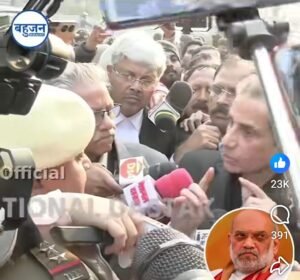
A disturbing question arises from the video showing police officers confronting advocates and citizens during a democratic protest: Can a police officer use the authority of his uniform, intimidating language or an alleged Supreme Court direction to prevent citizens from exercising their constitutional right to protest—without producing the order or establishing its applicability?
The video, which has circulated in connection with the protest led by Advocate Mehmood Pracha, deserves serious public and institutional scrutiny.
What is particularly concerning is the apparent exchange in which a police officer tells protesters, in substance, that the Supreme Court has ordered him to stop the protest. If that statement was made as represented, the obvious question is not political but legal:
What exactly did the Supreme Court order? When was it issued? To whom does it apply? What are its operative directions? And was the officer authorised to enforce it in the manner shown?
A constitutional democracy cannot operate on the principle that “the police officer says the Supreme Court ordered it, therefore citizens must obey.”
THE UNIFORM CANNOT BECOME A WEAPON OF INTIMIDATION
Police officers possess substantial coercive authority. Citizens do not.
That is precisely why police conduct during a peaceful democratic demonstration must be subject to a particularly high standard of professionalism, restraint and accountability.
The Constitution does not make peaceful disagreement with a government institution, including the Election Commission, a crime merely because the criticism is uncomfortable.
Citizens may question institutions. Advocates may challenge governmental action. Political opponents may demonstrate. Journalists may investigate. Civil-society groups may demand accountability.
These are features of democracy—not threats to it.
The right to peaceful assembly and expression is constitutionally protected, subject to lawful restrictions. The restriction must itself have a legal foundation.
“DON’T SCARE ME WITH YOUR RED EYES & DRESS”
One of the most striking moments in the video is Advocate Mehmood Pracha’s response to the officer’s manner of speaking.
His reported message was essentially that he would not be intimidated by the officer’s uniform, eyes or tone.
That exchange deserves attention because it raises a larger democratic principle:
A citizen should obey a lawful police direction. But a citizen should not be expected to surrender constitutional rights merely because a uniformed officer adopts an intimidating posture.
Indeed, an advocate challenging an officer’s assertion of legal authority should not automatically be portrayed as “disobedient” or “anti-police.”
The correct response to a disagreement over legality is documentation, transparency and due process—not provocation.
THE SUPREME COURT MUST NOT BECOME A BLANK CHEQUE
If an officer genuinely possesses a Supreme Court order restraining a particular demonstration, the remedy is extraordinarily simple:
Produce the order.
Let the protesters, their lawyers and the public see what the Court actually directed.
If the order exists and applies to the particular circumstances, it should be obeyed.
If it does not exist, or does not say what the officer claims it says, then invoking the Supreme Court’s name to intimidate citizens would raise a grave question of accountability.
Courts speak through their orders—not through an officer’s unsupported paraphrase of what a court supposedly decided.
This is why the Supreme Court itself has an institutional interest in ensuring that its authority is never casually invoked by anyone as a substitute for showing the law.
PROTEST IS NOT VIOLENCE
There is another distinction that must never be lost.
A peaceful protest and violent disorder are not the same thing.
If demonstrators attack police officers, damage property or engage in violence, the State has legitimate powers to intervene according to law.
But where citizens are peaceful, the State’s response must remain proportionate and lawful.
A democratic government cannot demand that citizens demonstrate only when the government finds their demands convenient.
The very purpose of a constitutional right to peaceful assembly is to protect disagreement.
ACCOUNTABILITY MUST APPLY TO POLICE OFFICERS TOO
If an investigation establishes that the officer:
- falsely represented the contents or existence of a Supreme Court order;
- deliberately threatened or intimidated peaceful protesters;
- used his position to provoke an otherwise peaceful advocate;
- exceeded his lawful authority; or
- attempted to manufacture a confrontation,
then appropriate disciplinary and, where legally warranted, criminal proceedings should follow.
But those conclusions should come after an impartial investigation of the complete video, the officer’s identity, the relevant orders, police records and eyewitness accounts.
The answer to alleged police misconduct cannot be another form of arbitrary power.
DO NOT HUMILIATE THOSE WHO STAND FOR DEMOCRATIC RIGHTS
There is also a larger moral issue.
People participating in democratic protests may disagree sharply with one another. They may belong to different political traditions. They may support different candidates, parties or institutions.
But the State must not turn political disagreement into personal humiliation.
Advocates who peacefully challenge authority should be treated with dignity.
Police officers should likewise be treated with dignity.
The uniform deserves respect—but the uniform does not place its wearer above the Constitution.
And an advocate’s professional status does not place him above the law either.
The same constitutional standard must apply to everyone.
A FIVE-POINT DEMAND FOR ACCOUNTABILITY
In view of the concerns raised by the video, the authorities should consider:
- Preserve and independently examine the complete video footage, rather than relying on edited clips.
- Identify the police officer involved and publish the relevant legal authority under which the protest was stopped.
- Produce the alleged Supreme Court order, if one was actually being relied upon.
- Order an impartial inquiry into whether the officer accurately represented the Court’s directions and whether his conduct complied with police rules.
- Ensure that future deployments at peaceful political or constitutional protests are led by properly trained officers in crowd management, constitutional rights and de-escalation.
If misconduct is established, disciplinary action should follow in accordance with law.
THE REAL TEST OF DEMOCRACY
The test of democracy is not whether citizens can praise those in power.
The test is whether they can peacefully question them.
The test of the rule of law is not whether ordinary citizens obey the police.
The test is whether the police themselves remain within the law.
And the authority of the Supreme Court is not strengthened when its name is invoked to intimidate citizens.
It is strengthened when every police officer, every politician, every advocate and every citizen knows that the Constitution stands above all of them.
If the video accurately captures what occurred, it warrants investigation—not dismissal.
And if an officer crossed the legal line, accountability should follow.
Police waley apni hud paar na karien – Advocate Mehmood Pracha Zindabaad
https://www.facebook.com/share/r/1HYXECgy8i/
No uniform should become a licence to intimidate.
No court order should be misrepresented.
No peaceful citizen should be bullied out of exercising a constitutional right.
Democracy survives when power is accountable—even when that power wears a uniform.
Ahmed Sohail Siddiqui
Senior Journalist, Editor & Author
********
POLICE WALEY APNI HUD PAAR NA KAREIN!
MEHMOOD PRACHA ZINDABAAD! ✊🇮🇳
Uniform izzat ka nishaan hai — dhamki ka licence nahi.
Jab ek peaceful protest mein police officer apni authority ka istemal karke advocates aur citizens ko rokta hai, aur Supreme Court ke order ka hawala deta hai, to sabse pehla sawaal hona chahiye:
“Order dikhaiye!”
Supreme Court ka naam lekar kisi citizen ko intimidate nahi kiya ja sakta. Court ke orders likhit hote hain; unki sharton aur applicability ko verify kiya ja sakta hai.
Advocate Mehmood Pracha ka police officer ke saamne khade hokar yeh kehna ki use uniform, aankhon ya tone se daraya nahi ja sakta, ek bade constitutional principle ki yaad dilata hai:
Police Constitution se upar nahi hai.
Peaceful protest aur violence mein farq hai. Agar koi violence kare, police ko kanoon ke mutabik action lena chahiye. Lekin agar citizens peaceful tareeqe se apni constitutional concerns—Election Commission, elections, EVMs ya voter rights—par protest kar rahe hain, to police ka kaam confrontation paida karna nahi, lawful order aur citizens ke rights dono ko protect karna hai.
Supreme Court ne khud peaceful assembly ke constitutional framework par cases mein restrictions ko reasonable and lawful hone ke sawal se joda hai.
Isliye hamari maang seedhi hai:
Police waley apni hud paar na karein.
Supreme Court ka naam lekar koi illegal ya misleading instruction na diya jaye.
Peaceful protesters ko intimidate na kiya jaye.
Police conduct ki independent inquiry ho.
Aur agar investigation mein kisi officer ki misconduct sabit hoti hai, to uske khilaf kanooni aur departmental action ho.
Hum violence ke khilaf hain.
Lekin constitutional rights ke surrender ke bhi khilaf hain.
MEHMOOD PRACHA ZINDABAAD!
PEACEFUL DEMOCRATIC PROTEST ZINDABAAD!
CONSTITUTION ZINDABAAD! 🇮🇳
Ahmed Sohail Siddiqui
Senior Journalist, Editor & Author
POLICE WALEY APNI HUD PAAR NA KAREIN!
MEHMOOD PRACHA ZINDABAAD! ✊🇮🇳
Uniform izzat ka nishaan hai — dhamki ka licence nahi.
Jab ek peaceful protest mein police officer apni authority ka istemal karke advocates aur citizens ko rokta hai, aur Supreme Court ke order ka hawala deta hai, to sabse pehla sawaal hona chahiye:
“Order dikhaiye!”
Supreme Court ka naam lekar kisi citizen ko intimidate nahi kiya ja sakta. Court ke orders likhit hote hain; unki sharton aur applicability ko verify kiya ja sakta hai.
Advocate Mehmood Pracha ka police officer ke saamne khade hokar yeh kehna ki use uniform, aankhon ya tone se daraya nahi ja sakta, ek bade constitutional principle ki yaad dilata hai:
Police Constitution se upar nahi hai.
Peaceful protest aur violence mein farq hai. Agar koi violence kare, police ko kanoon ke mutabik action lena chahiye. Lekin agar citizens peaceful tareeqe se apni constitutional concerns—Election Commission, elections, EVMs ya voter rights—par protest kar rahe hain, to police ka kaam confrontation paida karna nahi, lawful order aur citizens ke rights dono ko protect karna hai.
Supreme Court ne khud peaceful assembly ke constitutional framework par cases mein restrictions ko reasonable and lawful hone ke sawal se joda hai.
Isliye hamari maang seedhi hai:
Police waley apni hud paar na karein.
Supreme Court ka naam lekar koi illegal ya misleading instruction na diya jaye.
Peaceful protesters ko intimidate na kiya jaye.
Police conduct ki independent inquiry ho.
Aur agar investigation mein kisi officer ki misconduct sabit hoti hai, to uske khilaf kanooni aur departmental action ho.
Hum violence ke khilaf hain.
Lekin constitutional rights ke surrender ke bhi khilaf hain.
MEHMOOD PRACHA ZINDABAAD!
PEACEFUL DEMOCRATIC PROTEST ZINDABAAD!
CONSTITUTION ZINDABAAD! 🇮🇳
Ahmed Sohail Siddiqui
Senior Journalist, Editor & Author
https://www.facebook.com/share/r/1HYXECgy8i/
[Video: Advocate Mehmood Pracha confronting the police officer]