
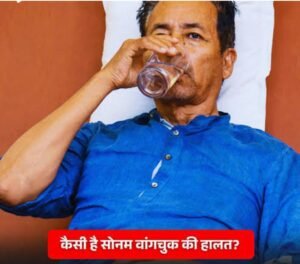
 Sonam Wangchuk Lives – Indian Democracy Dies?
Congress, BJP and the Search for an Ideological Opposition

By Ahmed Sohail Siddiqui
The violent clashes between protesting students and the Delhi Police have once again raised fundamental questions about the health of Indian democracy. Regardless of political affiliation, any democracy must ask whether excessive force against peaceful demonstrators strengthens the rule of law or weakens public faith in democratic institutions.
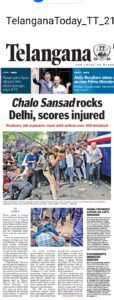
A central political question is whether Union Home Minister Amit Shah, who oversees policing in Delhi through the Ministry of Home Affairs, should accept political responsibility for incidents in which students are allegedly subjected to excessive police action. In many parliamentary democracies, ministers are expected to answer for the conduct of agencies under their authority, even when they are not personally involved in operational decisions.
Yet responsibility does not end with the government alone.
Opposition parties and protest organisers also bear a moral responsibility for the safety of those they encourage to participate in demonstrations. If young students are mobilised to confront heavily equipped police forces, leaders must carefully assess whether they have adequate legal, organisational and safety arrangements in place.
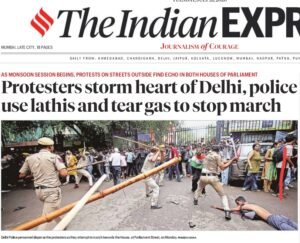
The events surrounding recent protests therefore deserve scrutiny from every angle. Public figures associated with the movement—including Sonam Wangchuk, activist Abhijeet Dipke, leaders of the Aam Aadmi Party, the Samajwadi Party, Left student organisations and other political groups—may legitimately be asked what preparations they made to protect participating students. Such questions are part of democratic accountability, although answers may differ and should be based on evidence.
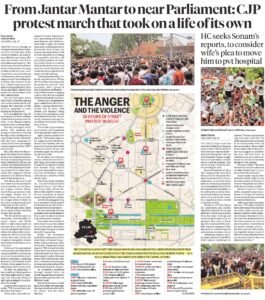
Similarly, Left-affiliated student organisations, including AISA, may also face questions about their strategy and whether confrontation with the police served students’ interests or exposed them to unnecessary risks.
At the same time, criticism must extend equally to the authorities. The state possesses overwhelming coercive power. Police forces receive professional training, equipment and legal authority unavailable to ordinary citizens. Their conduct is therefore subject to a higher standard of restraint and accountability.
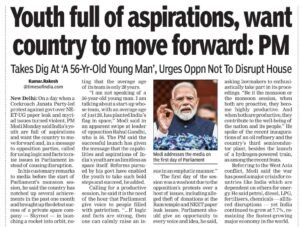
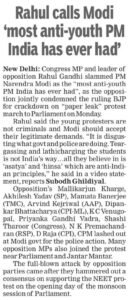
The Congress leadership’s response has also triggered debate. Rahul Gandhi and Priyanka Gandhi Vadra visited injured students and expressed solidarity with the protesters. During these demonstrations, slogans critical of the Modi government were prominently raised. Some Congress supporters viewed this as a necessary expression of opposition politics, while critics argued that the party appeared to rely heavily on slogans associated with Left organisations instead of articulating a distinct ideological vision of its own.
Jab-Jab Modi Darta hai – Police ko Aagey Karta hai
This criticism extends beyond slogans. For years, observers have debated whether the Congress has developed a coherent ideological response to the BJP’s vision of Hindutva and the idea of a Hindu Rashtra. Critics argue that unless the Congress offers a clear constitutional and political alternative, it risks merely reacting to the BJP rather than defining an independent national agenda.
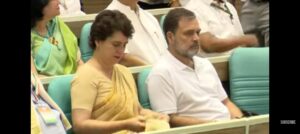
Within this broader debate, some critics have also questioned the role of senior Congress leader Rajeev Shukla, alleging that his political positions often appear more accommodating towards the BJP than confrontational. Such assessments remain political opinions rather than established facts, but they illustrate the internal debates taking place within sections of the opposition.
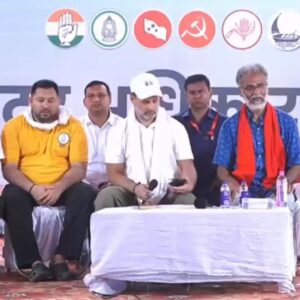
Ultimately, democracy demands accountability from every participant. Governments must answer for police conduct. Opposition parties must answer for protest strategy. Activists must answer for the safety of those they mobilise. Political leaders must ensure that students are not transformed into symbols while others remain safely distant from physical confrontation.
India’s constitutional democracy cannot be defended merely through slogans. Nor can it be protected through force. It survives only when both the government and the opposition accept responsibility for their actions and place the lives and dignity of citizens above partisan politics.
The true measure of democratic leadership is not how effectively it mobilises crowds, but how successfully it protects the people who answer its call.
********